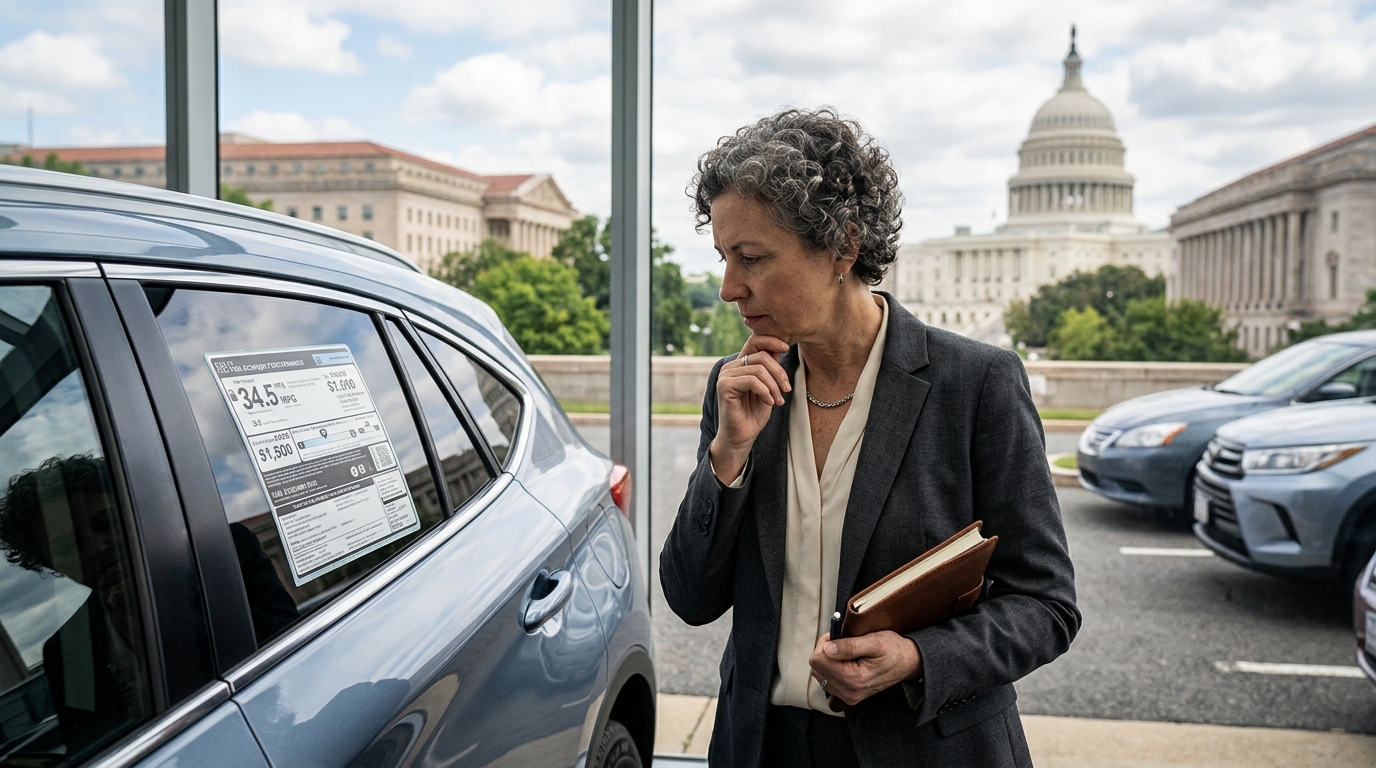
Washington is finalizing sharply lower fuel economy standards today, capping a regulatory reversal that began in December 2025 when NHTSA proposed its SAFE III rule. The agency is set to confirm a fleetwide average of roughly 34.5 miles per gallon by model year 2031, compared with the Biden-era trajectory that was expected to be far higher by the end of the decade. If finalized as proposed, the rule resets average fuel economy requirements back to model year 2022 standards, raising them by only 0.5% per year through MY 2026 and 0.25% per year through MY 2031, well below the increases in the 2024-era rulemaking. On the same day, NHTSA moved to reverse the rule regulating standalone medium- and heavy-duty truck engines.
The headline mpg number is almost beside the point for investors. The real question is what the retroactive credit reset does to the economics of every automaker you might own.
Tesla: The Credit Well Has Already Run Dry
Under the Biden rules, Tesla sold compliance credits to traditional automakers who needed them to avoid fines. That business was worth real money. According to Tesla’s Form 10-Q for the quarter ended June 30, 2026, automotive regulatory credits came in at just $146 million for the quarter, down from $439 million in the same quarter of 2025.
The mechanism behind that collapse matters. The Trump administration’s One Big Beautiful Bill Act eliminated monetary civil penalties for automakers that fail to meet CAFE standards, cutting a major reason some automakers paid up for credits. Today’s proposed SAFE III approach extends that logic: the proposal would eliminate inter-manufacturer credit trading starting in model year 2028.
Analysts have long warned that Tesla’s U.S. credit revenue would fall as rules and incentives shifted. The Q2 2026 actuals suggest that timeline may be arriving faster than many investors expected.
GM and Ford: The Retroactive Reset Is the Profit Lever
For Detroit, the credit collapse is a feature, not a bug. For traditional automakers like GM and Ford, the policy change is a financial breather. Reports have described the rollback as potentially freeing up billions for Detroit carmakers to reinvest in gasoline-powered and hybrid vehicles, with Ford CEO Jim Farley calling it a “multibillion-dollar opportunity” for its gas and hybrid business.
The retroactive component of today’s rule, resetting standards back to a 2022 baseline, is the subtler gain. Because the proposal covers model years 2022 to 2031, it would apply to future model years and also loosen requirements for prior model years still within the compliance window. Credits that legacy automakers banked under the old, tighter rules had limited residual value. With the baseline reset lower, those same manufacturers can find themselves in surplus rather than deficit, reducing the urgency to purchase credits at all.
Rollback of fuel-economy standards was already expected to support sales of profitable trucks and SUVs while easing pressure to push money-losing EV volumes. Ford lifted its full-year adjusted EBIT guidance to $10 to $11 billion on July 28, 2026, while GM raised its own full-year EBIT-adjusted range to $14 to $16 billion on July 21, 2026. Full-size pickups remain the profit center: Ford reported first-half 2026 F-Series sales of 357,801 units, and Ford said that was more than 80,000 units ahead of the second-place Chevrolet Silverado through June 2026. Looser rules mean those trucks become less of a regulatory liability and more of a pure profit engine.
The Practical Takeaway for Your Portfolio
The split is clean. Tesla’s high-margin credit revenue stream looks structurally impaired in the U.S. market as penalties and trading mechanisms change. The company remains profitable on vehicles and energy, but one meaningful earnings cushion is shrinking. GM and Ford, by contrast, enter the second half of 2026 with trucks that no longer subsidize the same kind of compliance burden. Stellantis also stands to benefit from a lighter compliance load on its Ram and Jeep lineups.
Position sizing matters here. The CAFE rule lands today, but litigation is nearly certain. CAFE rulemakings have regularly been followed by extensive litigation, and this one is likely to be no exception. A court stay could restore some credit value temporarily, a risk for GM and Ford shorts and a potential lifeline for Tesla longs. The underlying directional shift, though, is settled policy: lower bars, lower credit prices, and trucks that sell themselves with less regulatory drag.