August 18, 2026
BIDU: What the Options Already Knew
Volatility was elevated well before Tuesday’s print. The signal was worth reading.
First a note from Profits Run
If you still haven’t downloaded my “Simple Options Trading For Beginners” book…
…please take a few seconds and download it right now before your new temporary download link expires.
I eventually plan to charge for this book, so do yourself a favor and download it now…
That way, no matter how much it is in the future, you’ll have a copy on your computer already.
Make sense?
FREE: Simple Options Trading For Beginners << Download Now
Good Trading,
Bill Poulos
P.S. Go here to save a copy of my “Simple Options Trading For Beginners” book to your computer before I start charging for it.
BIDU: What the Options Already Knew
The Signal
Before Baidu reported a single number Tuesday morning, the options market had already told a clear story. August implied volatility on BIDU reached 81, well above the stock’s 52-week IV range of 35 to 66. September IV was sitting at 51. The term structure was in steep backwardation, with front-month contracts pricing far more uncertainty than the months that follow. That is not a neutral posture. That is the options market saying: something happens here, and traders are not agreed on which direction.
The August 104 straddle was priced for a move of roughly 7.1% to 7.5% in either direction. That implied move was not arbitrary. It was almost double the 4.35% average realized move seen across the prior eight quarters. Options were pricing something closer to a tail event than a routine quarterly update. The call/put ratio heading into the report was 1.3 calls to 1 put in the morning session, with notable flow concentrating in August 130 calls. By the mid-session on August 17, the ratio had flipped to 1 call for every 1.2 puts. A shift like that, from call-heavy to put-heavy in a single session before earnings, is not random noise. It is repositioning.
Why Sophisticated Participants Were Paying Attention
Baidu was not a name traders were watching casually. This was a stock that had already declined nearly 30% year-to-date before Tuesday, sitting at a price-to-sales ratio of 1.9 times against a peer group average above 4 times. It had missed analyst estimates for four consecutive quarters going into this report. The fifth consecutive miss was a real scenario, and the options market was not ignoring it.
At the same time, the structural story is not simple. GPU Cloud revenue had grown 184% year-over-year in Q1. The question heading into Q2 was whether that growth rate was accelerating or plateauing. If it was accelerating, the bull case for a sharp re-rating had legs. If it was plateauing, the advertising drag was going to dominate the headline again. That binary created real asymmetry. Traders on both sides had a reason to be in the options market, which is why volume, open interest, and IV all expanded together ahead of the report. Nomura’s Jialong Shi had already cut his price target from $190 to $170 while projecting a 22% drop in ad revenue. BofA’s Miranda Zhuang maintained a Buy but lowered her target from $180 to $165 and trimmed operating profit estimates for 2026 through 2028 by 3% to 8%. Analyst sentiment going in was cautious, not bearish, and that ambiguity fed the elevated implied move.
The Company Behind the Signal
Baidu reported Q2 2026 revenue of RMB 31.33 billion, down 4% year-over-year and below the RMB 31.95 billion analyst consensus. Non-GAAP EPS came in at RMB 7.22, against expectations of RMB 9.84. GAAP net income was RMB 2.3 billion on a 7% net margin, with GAAP net income down 68% year-over-year. That last number carries weight. The transition to an AI-first operating model is not free, and the income statement is showing the cost clearly.
Capital expenditures nearly tripled year-over-year to RMB 11.37 billion in the quarter, pushing free cash flow to negative RMB 8.27 billion. Cost of revenue rose 4% year-over-year to RMB 19.1 billion, driven by AI cloud-related costs. This is the part of the Baidu story that the GPU Cloud headline obscures. The infrastructure is compounding. The spending required to build it is compounding faster.
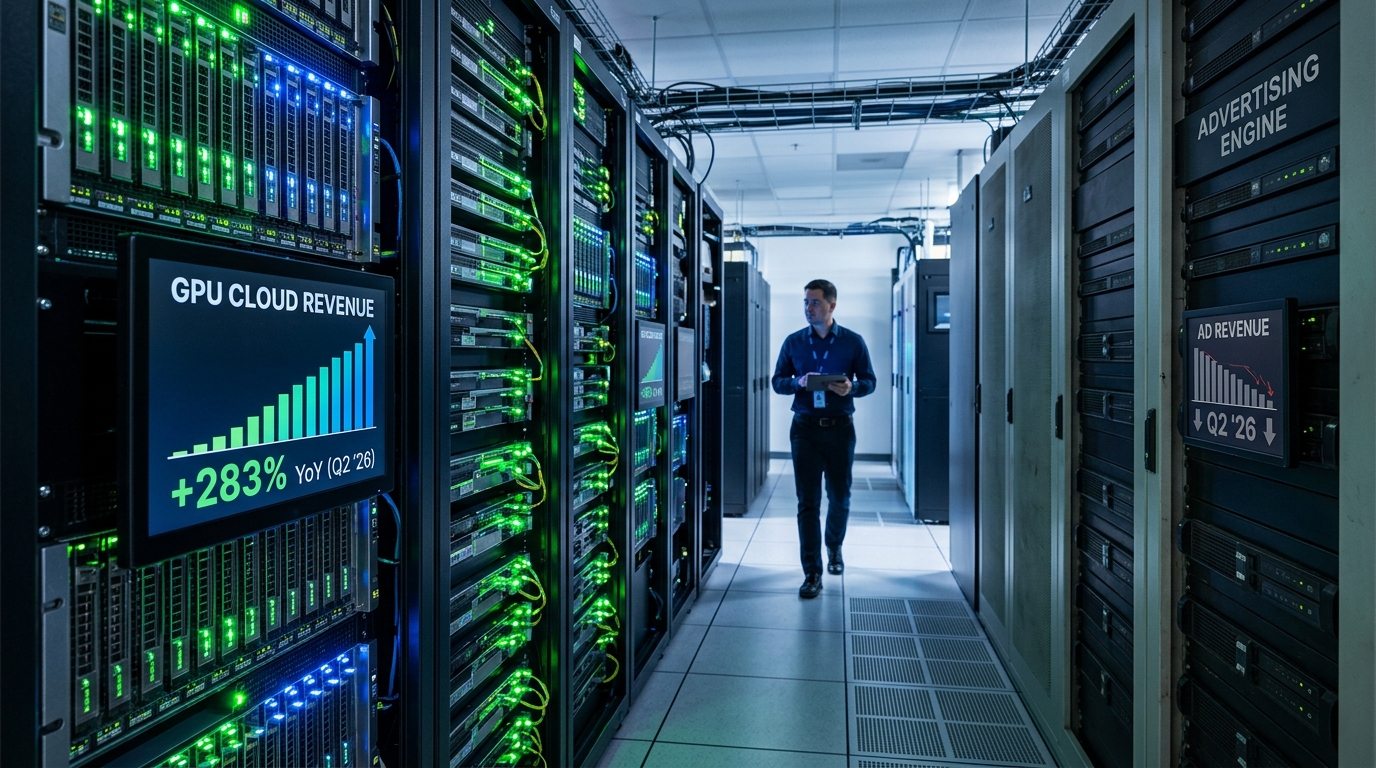
On the growth side, AI Cloud Infrastructure revenue reached RMB 7.3 billion, up 50% year-over-year. Within that, GPU Cloud revenue grew 283%, accelerating from 184% in Q1. Core AI-powered business revenue rose 25% to RMB 12.5 billion, now accounting for half of Baidu’s general business revenue. Revenue from embodied AI customers grew roughly sixfold year-over-year. Non-GAAP operating income was RMB 3.8 billion on a 12% margin.
The counterweight is equally concrete. Online marketing revenue fell 19% to RMB 13.1 billion. Management explicitly warned that online marketing will remain under pressure through the second half of 2026. AI Applications revenue, the layer that should eventually monetize all that infrastructure investment, grew just 3% to RMB 2.5 billion. GPU Cloud is compounding at 283%. The products built on top of it are compounding at 3%. That gap is the central tension in the investment case, and the options market priced it correctly by refusing to pick a side.
Apollo Go delivered approximately 1 million fully driverless rides in Q2 and began open-road testing in London in partnership with Uber. Dubai, Switzerland, and Kazakhstan deployments are underway or planned. None of this is in the revenue line yet. When recognized revenue from international AV deployments begins to show up, the segment mix changes. The timing of that recognition is unknown, which is another reason options traders were reluctant to hold a strong directional bias into the report.
ELON’S $25 TRILLION “A.R.M.” PROJECT?
Elon Musk says this technology could eventually drive $25 trillion in new wealth – more than the entire Magnificent 7 combined.
And James Altucher believes he’s uncovered the little-known company behind it.
He calls Elon’s secretive new project “A.R.M.”
Most Americans have never heard of it.
What Was Actually Priced In
The implied move of 7.1% to 7.5% was well above the 4.35% average from the prior eight quarters. History offered a wider range than that average suggests: the smallest move over those eight quarters was 1.76%, and the largest was 11.5%, which came after the November 2025 report when shares dropped sharply against a 4.8% expected move. The May 2026 quarter went the opposite direction: options priced a 6.9% move, the stock fell just 2.4%.
That asymmetry matters. BIDU has a history of realized moves that either dramatically overshoot or undershoot implied volatility. The August straddle was pricing for the former. The call concentration in August 130 strikes implied a cohort was positioned for a significant upside beat, the kind of result that would come if GPU Cloud growth surprised further and advertising showed any sign of stabilizing. That scenario did not materialize. BIDU shares fell roughly 3.5% to 7% in premarket trading Tuesday, landing inside the implied move but firmly to the downside.
The call heavy positioning in August 130 strikes, strikes roughly 25% above the pre-earnings price, was almost certainly speculative rather than hedging. Nobody hedges with 130 calls on a stock trading near $104. Those were directional bets on a blowout quarter. They lost. The put-heavy shift in the mid-session on August 17 suggests some of the smarter money was reading the risk correctly and repositioning before the open.
Strategic Considerations
The immediate post-earnings environment for BIDU options is defined by one condition: IV was elevated well above its 52-week range heading into the report, and the vol crush that follows an earnings event will compress near-month premium significantly. August IV at 81 against a 52-week range ceiling of 66 means premium sellers had structural pricing on their side even before knowing the direction of the move. That advantage persists through expiration.
For traders who believe the post-earnings drift is largely complete and that BIDU consolidates in the $95 to $120 range, a short iron condor in September expiration collects premium on both sides while defining maximum loss to the width of either spread minus the credit received. This approach suits a view that the stock digests the report without making a sustained directional move. The risk is a secondary leg lower if institutional holders reassess the fifth consecutive miss over the following weeks.
For traders who believe the GPU Cloud acceleration at 283% is durable and that advertising is within a quarter or two of bottoming, a bull call spread targeting the $105 to $115 range in October expiration limits premium outlay while capturing the range where analyst fair value estimates cluster. BIDU trades at 14x forward earnings and 3.3x EV/EBITDA. Those multiples do not require high growth to justify fair value. Risk is capped to the net debit paid. The bull case does not require the advertising business to recover. It requires the AI revenue line to grow large enough that the advertising decline becomes less relevant to the total revenue picture. Q2 shows that crossover is approaching but has not arrived.
For traders who believe the fifth consecutive miss signals deterioration that is structural rather than cyclical, and that management’s explicit warning about continued advertising pressure through H2 2026 plays out while capex stays elevated and free cash flow remains deeply negative, a bear put spread using October $100 and $90 strikes defines risk to the debit while targeting the lower end of pre-earnings support. Shares entered Tuesday down 28.3% year-to-date and 37% below their 52-week high of $165.30. The downside case carries additional tail risk from the U.S. Department of Defense designation of Baidu as a Chinese military-aligned entity. Any escalation in U.S.-China tech policy resets the risk framework independent of operating results.
Across all three scenarios, the post-earnings IV environment favors defined-risk structures over outright long options. Buying calls or puts outright after a vol crush means paying for premium that has already deflated from its pre-earnings peak. Spreads in September or October expiration reduce gamma exposure while keeping maximum loss to the net debit or net risk in the position.
What to Watch From Here
The thesis resolves, or breaks, on a small number of observable developments over the next 60 to 90 days.
- GPU Cloud growth rate in Q3. A continuation above 200% year-over-year sustains the AI infrastructure thesis. Deceleration below 150% puts the bull case under real pressure and likely brings further analyst target cuts.
- Online marketing revenue trend. Management warned of continued pressure through H2 2026. A decline steeper than 19% in Q3 signals the macro headwind is worsening. Any sequential stabilization, even flat at the 19% decline, changes the tone of the next earnings call.
- AI Applications revenue acceleration. The 283% GPU Cloud versus 3% AI Applications gap is not sustainable as a signal of a healthy business. Convergence in those two growth rates is what a multiple expansion requires. Watch for any acceleration above 10% in Q3.
- Capex trajectory and free cash flow. Capital expenditures nearly tripling year-over-year with free cash flow at negative RMB 8.27 billion is the part of the report that got less attention than GPU Cloud growth. If capex stays at this level without a corresponding acceleration in revenue, the balance sheet conversation changes. Total cash and investments stood at RMB 279.3 billion as of March 31. That is a large buffer, but it is being drawn on faster than the headline growth metrics suggest.
- Apollo Go revenue recognition. Open-road testing in London, commercial operations in Dubai, and expanding international partnerships are pre-revenue events today. Any announcement of recognized commercial revenue from international deployments marks a genuine inflection in the segment mix math.
- August 26 shareholder vote. Baidu’s dual-primary listing conversion on the Hong Kong Stock Exchange is subject to shareholder approval at an extraordinary general meeting on August 26. A successful vote widens the investor base and provides a secondary liquidity event that could incrementally support the stock.
- Geopolitical posture. The DoD designation of Baidu as a Chinese military-aligned entity is a background risk that can become a foreground event quickly. Any policy escalation affecting Chinese ADRs overrides the fundamental picture regardless of how GPU Cloud or Apollo Go perform operationally.