August 17, 2026
BABA at 17x Earnings: Cheap or Broken?
The market prices Alibaba like a company in permanent decline. The numbers suggest a different story entirely.
BIGGER THAN SPACEX? 🚀
Elon Musk is preparing to roll out what he calls “the biggest product ever of any kind.”
James Altucher calls it “A.R.M.”
Elon says the opportunity could eventually drive $25 trillion in new wealth – and James believes he’s uncovered the little-known company supplying the critical technology behind it.
Hey there, bargain hunter. Let me ask you something. When a company accumulates more global downloads than Meta and Google combined in a six-month span, builds $41 billion in net cash, repurchases more than 25 million of its own shares in a single quarter, and trades at 46% below its 10-year average price-to-earnings ratio, what should you call it?
Wall Street calls it a disappointment. Four consecutive quarters of missed adjusted EPS will do that. The market has a long memory for miss streaks and a short one for the reasons behind them. Right now, Alibaba is paying the perceptual price for a deliberate, documented, time-limited investment cycle that the company itself has quantified down to the renminbi. And on Thursday, August 20, it reports again.
This is the week to think carefully about whether perception and reality have diverged on BABA. Not whether the stock will pop Thursday morning. Whether the business is being priced correctly at all.
Scoreboard: What the Market Sees
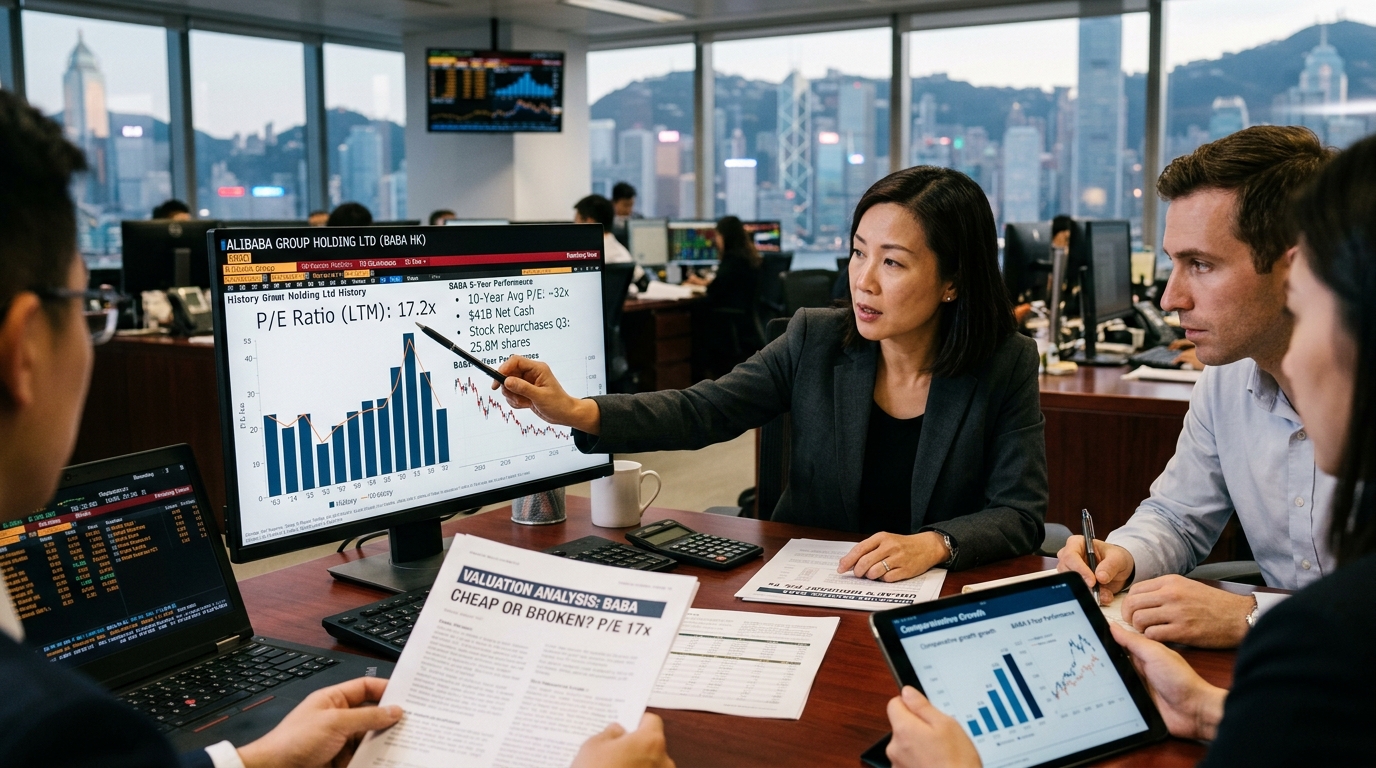
BABA closed Friday at approximately $124. The trailing P/E ratio sits at 17.41, against a 10-year historical average of 32.31. That current multiple is 46% below the historical norm. The forward P/E, as of July 1, 2026, was 14.99. EV/EBITDA, as of July 8, 2026, stands at 12.05.
On the revenue side, the full fiscal year 2026 numbers have already landed. FY2026 revenue came in at RMB 1.02 trillion, an increase of 2.74% year over year. Earnings fell 18.2%. The EPS trajectory has declined as the company accelerates investment. The consensus outlook for FY2026 EPS has deteriorated, with the revenue forecast decreasing from RMB 1.04 trillion to RMB 1.03 trillion, and the EPS estimate falling from RMB 47.31 per share to RMB 39.64 per share.
For Thursday’s June-quarter (Q1 FY27) report: consensus revenue sits at RMB 268.86 billion, representing 8.6% growth year over year, with adjusted EPS expected down 29% year over year. BABA has missed EPS estimates in four consecutive quarters. The stock, despite all of that, has 40 analysts rating it Strong Buy. The 12-month average price target is $189.60, implying 52.56% upside from the current price.
Those two facts sitting side by side tell you something. The market is punishing execution in the near term. The analysts think the business is worth dramatically more. Both can be right simultaneously — the question is which one is right about the time horizon that matters to you.
The Real Reason It’s Here
Alibaba’s discount is not mysterious. The company committed at least RMB 380 billion ($53 billion) in cloud and AI infrastructure spending across three fiscal years. Last quarter alone, AI and cloud capex ran approximately $5.4 billion. That spending compresses EPS mechanically. When earnings fall four quarters in a row while the commitment is being made, the market prices the pain in the present tense and discounts the return as speculative.
Alibaba reported its first operating loss since early 2021 as heavy spending on AI, cloud, and quick-commerce weighed on margins. The instant commerce war between Alibaba, Meituan, and JD requires sustained subsidies. Core e-commerce profitability in the March quarter dropped sharply as Taobao Instant Commerce investments accelerated. Add the regulatory hangover from a $600 million Department of Justice settlement over AliExpress pharmaceutical sales, an unresolved securities class action, and a Pentagon designation as a Chinese military company that has cooled institutional interest in the U.S., and you have a stock that carries more than its share of headline risk.
That is what the market sees. The question The Cheap Investor always asks next is: are these problems temporary or permanent?
The Business Behind the Discount
Strip away the headlines and the quarterly misses and you have a company that built the most-used AI model ecosystem on the planet this year. Alibaba’s open-weight models have accumulated more than 3 billion global downloads in the past six months, eclipsing Meta Platforms, Alphabet, and domestic peers to become the world’s No. 1 artificial-intelligence model.
The scale of that advantage deserves a number. The Hugging Face state of open models report, published on August 14, showed Google models had 418 million downloads in 2026, while Meta’s models had 227 million downloads. The Qwen ecosystem now includes more than 460 open-weight models and has generated over 300,000 derivative models. As Hugging Face wrote in that report, “Qwen has become part of the default workflow for developers deciding what models to fine-tune and deploy.”
That is not a marketing claim. It is a structural position. When developers default to your model architecture, the downstream commercial relationships — cloud hosting, enterprise API access, fine-tuning services — follow. Alibaba has bolstered that cycle by distributing Qwen through its cloud platform to enterprise customers in markets including Southeast Asia and Africa, giving it a reach that many rivals lack.
How to screw everything up and get paid for it
Elon Musk just secured a $29B handout from Tesla’s board to help “keep his energies focused.” It’s an obscene reward when the company’s much-hyped pivot from EV to AI is still unproven, and its Optimus robot has zero pre-orders. But there’s a much better play here… a little-known robotics stock already landing the kinds of huge deals Tesla can only dream of. This company’s robots are in such high demand, it’s already facing a $23 million backlog. Get the name, ticker and analysis free. No paywall. No strings.
The Cloud Intelligence Group is where this converts to revenue. In the March quarter, the unit grew 38% year over year. AI-related products accounted for 30% of external cloud revenue. Management has guided that AI products could exceed 50% of external cloud revenue within roughly a year. Morgan Stanley projects the June quarter could show 45% growth.
The monetization question hanging over Thursday’s call is whether the open-weight model strategy — which has generated 3 billion downloads under permissive licensing terms and essentially zero direct licensing revenue — is about to change. Reuters reported in the first week of August that Alibaba plans to require large commercial users of the open-weight Qwen3.8-Max to share a portion of the revenue they generate from it. Since the Qwen3.8-Max launch, catalysts have piled up: Apple now lets Mac users in China connect Qwen AI to Siri and Writing Tools, and Tesla is beta-testing Qwen in vehicles in China for voice recognition and navigation. Those integrations are proof of commercial adoption at scale. A licensing structure that captures a fraction of that commercial value changes the financial picture in ways that no current consensus model reflects.
Deep Dive: How the Business Makes Money
Three revenue pillars. Different trajectories. Different problems.
China E-Commerce (Taobao, Tmall, Taobao Instant Commerce) is the legacy margin engine and the current problem child. When Alibaba is not subsidizing instant commerce competition, China E-Commerce generates substantial operating profit. Right now, it is subsidizing heavily. The unit economics of Taobao Instant Commerce are improving sequentially but are not yet breakeven. Management has not given a precise timeline. Until they do, this segment will depress consolidated margins.
Cloud Intelligence Group is the growth engine. From 38% growth last quarter to an expected 40% to 45% this quarter, Cloud is accelerating while the rest of the business is consolidating. AI-related product revenue running at an annualized pace approaching RMB 36 billion is the financial evidence that the infrastructure investment is producing customers, not just capacity. Cloud margins are improving — Morgan Stanley projects approximately 11% for the coming quarter.
International Digital Commerce (AliExpress, Lazada, Trendyol) operates in markets where Alibaba is a challenger rather than a dominant player. Growth has been inconsistent. The DOJ settlement over AliExpress pharmaceutical sales removed a legal overhang but also underscored the compliance complexity of running a global marketplace from China. This segment is the most optionality-heavy: it could be meaningfully valuable in five years, or it could be spun off or restructured. For now, treat it as a free call option in the valuation.
The Data Section: What the Numbers Actually Show
- FY2026 Revenue: RMB 1.02 trillion, +2.74% year over year. Modest, but stable at the top line even during a heavy investment cycle.
- Trailing P/E: 17.41 as of late July 2026. The mean historical P/E over the past ten years is 32.31. The current multiple represents a historically deep discount to the company’s own baseline.
- Forward P/E: 14.99 as of July 1, 2026. The five-year average forward P/E is 13.01, meaning on a forward basis the stock is not egregiously cheap relative to recent history — but the forward EPS estimate includes continued capex drag that may not last.
- EV/EBITDA: 12.05 as of July 8, 2026. This is above the 2025 reading of 11.25, reflecting the capex-driven EBITDA compression, but remains below the multiples of U.S. cloud peers who grow at similar rates.
- PEG Ratio: 0.59. A PEG below 1.0 means the market is paying less per unit of growth than the growth rate implies. For a company growing cloud revenue at 38% to 45%, a PEG of 0.59 is a notable discount.
- Balance Sheet: $41 billion in net cash, with sufficient liquidity to fund the $52 billion three-year capex plan without external financing. The March 2026 balance sheet shows cash and short-term investments of approximately RMB 286 billion combined.
- Shareholder Returns: $11.9 billion in share repurchases in FY2025, representing a 5.1% reduction in share count. Under a repurchase mandate approved in September 2025, Alibaba confirmed compliant buybacks totaling over 25 million shares. $19.1 billion remains under buyback authorization through March 2027.
- Debt Profile: Debt/Equity ratio of 0.25. The leverage is conservative for a company of this size. This is not a balance sheet that breaks under stress.
- Q1 FY27 Consensus: Revenue RMB 268.86 billion (+8.6% YoY), adjusted EPS RMB 10.46 per ADS (-29% YoY). Cloud Intelligence Group external revenue expected +38% to +45% YoY.
The Department of War Is on a Gold Mine’s Filings
On May 21, 2026, the board of a federal bank voted unanimously to lend nearly $3 billion to build a gold mine on American soil. Congress got 25 days notice. Nobody objected.
Final papers are expected in the second half of this year. The day that ink dries, three things happen at once:
One more detail. The company’s own filings cite “substantial support and partnership from the Department of War,” a phrase we’ve never seen on a gold project. The reason: alongside its gold, the deposit holds a metal China formally banned from export to the United States. The only domestic reserve in the country.
The company is about one fiftieth the size of Newmont.
Is It Cheap? The Valuation Test
Let’s be disciplined here. Alibaba is not obviously cheap on every metric. The EV/EBITDA of 12.05 is not a screaming bargain in isolation. Deteriorating recent financial performance — margin and return-on-equity compression alongside negative free cash flow — has weighed on the stock’s valuation signal. The free cash flow has turned negative because of the capex cycle, which removes one of the value investor’s most reliable anchors.
But look at the combination:
- A trailing P/E of 17x against a 10-year average of 32x suggests the market is applying a roughly 50% discount to normalized earnings power.
- A PEG of 0.59 on a business growing cloud revenue at 38% to 45% annually suggests the growth is not being priced at all.
- $41 billion in net cash on the balance sheet provides a floor that limits permanent capital impairment even in a bear scenario.
- At 18.7x trailing and forward earnings, BABA trades at a significant discount to U.S. tech peers.
- The capex compression of EPS is time-limited. The $53 billion, three-year commitment has a defined endpoint. When capex normalizes, earnings normalize. The market is pricing today’s depressed EPS as if it represents the permanent earnings power of the business. That is the mispricing.
The fair value upside suggests the market has not fully priced in the AI optionality. But EPS growth is negative and revenue growth has been tepid, so the cheap multiple partly reflects real fundamental deterioration. That is an honest assessment. The investment case is not that Alibaba is obviously undervalued on every measure today. It is that the market is extrapolating the current investment cycle forward indefinitely, and history says investment cycles end.
Cheap Investor Scorecard
- Business Quality: 8/10. Dominant e-commerce franchise, world’s #1 open AI model by downloads, and an accelerating cloud unit that grew 38% last quarter. The core business quality is not in dispute.
- Financial Strength: 7/10. $41 billion in net cash, a Debt/Equity ratio of 0.25, and sufficient liquidity to fund the full $53 billion capex plan without external financing. FCF is temporarily negative due to the investment cycle, not structural impairment.
- Valuation: 8/10. Trailing P/E of 17x versus a 10-year average of 32x. PEG of 0.59. Wide discount to U.S. tech peers on comparable cloud growth rates. The discount is historically deep and requires a pessimistic permanent-impairment assumption to justify.
- Competitive Position: 9/10. 3 billion Qwen downloads in six months. More than 300,000 derivative models built on Qwen architecture. Self-developed AI chips at scale in China. Apple and Tesla integrations confirmed. The moat in the open AI model ecosystem is real and widening.
- Balance Sheet: 8/10. Conservative leverage, $41 billion in cash, and no financing risk on the capex commitment. This balance sheet does not break under a bear scenario.
- Cash Flow: 5/10. Free cash flow is currently negative due to the capex cycle. Operating cash flow remains positive. The FCF pressure is the clearest near-term weakness in the financial profile and the most visible reason for the P/E discount.
- Management Execution: 6/10. Four consecutive EPS misses is a documented pattern. The Qwen ecosystem has outperformed any reasonable pre-launch expectation. The capex commitment is transparent and time-bounded. Execution on financial targets has lagged; execution on the AI product roadmap has exceeded it.
- Catalyst Strength: 8/10. Three potential re-rating catalysts converge on August 20: cloud growth confirmation, Qwen commercial licensing announcement, and capex cycle peak signal. None of the three is in consensus models at full value.
- Margin of Safety: 7/10. The $41 billion cash floor, the 46% P/E discount to historical average, and the active $19.1 billion buyback authorization collectively provide meaningful downside cushion. Permanent impairment requires assuming the cloud business stops growing. That assumption is not supported by the data.
- Long-Term Potential: 9/10. AI model monetization is beginning. Cloud is at 40%+ growth with an expanding share of external revenue. Southeast Asia and Africa represent underpenetrated markets for both e-commerce and cloud. The Qwen licensing mechanism, if formalized, adds a revenue stream that no analyst has yet modeled at full value.
Bull / Base / Bear
Bull Case
Cloud Intelligence Group reports 45% growth Thursday. Management announces formal commercial licensing terms for large Qwen users. Quick-commerce unit economics improve enough for management to put a breakeven timeline on record. Capex guidance shows the peak of the investment cycle is either reached or visible. The stock re-rates toward $145 to $155 over the next two to three quarters as analysts revise forward EPS upward and the P/E multiple expands from 17x toward 22x on a normalized earnings base. Fair value models suggest 17.8% upside to $155.93 on this scenario, with analyst consensus pointing to $190 over 12 months.
Base Case
Cloud grows 38% to 42%, roughly in line with last quarter. EPS misses consensus modestly but cloud margin commentary is constructive. Qwen licensing terms are discussed directionally but not formalized. The stock moves 4% to 7% post-earnings, settles in the $125 to $135 range, and grinds higher over the next two quarters as capex peak becomes clearer. The 17x P/E persists until a consecutive EPS beat demonstrates the cycle has turned. This is the most probable outcome, and it is still a compound returns story from here at a below-historical-average multiple.
Bear Case
A fifth straight EPS miss. Cloud decelerates below 35% — which would be a sequential regression from the March quarter’s 38% and the single most damaging data point for the thesis. Quick-commerce losses worsen. Qwen licensing commentary is absent or indefinitely delayed. Geopolitical risk escalates, with a new export control headline or a worsening Pentagon designation situation reducing institutional investor participation. The stock retests $110 to $115, where the 50-day and 100-day EMAs have historically provided support. The $41 billion net cash position provides a genuine floor on permanent impairment in this scenario. Alibaba cannot go to zero with $41 billion in cash and a cloud unit growing at 35%+. It can, however, stay cheaper for longer than any value thesis would prefer.
Action Plan for the Patient Bargain Hunter
This is not a trade. If you are looking for a three-day position around an earnings binary, the options editorial companion to this piece covers that territory. This is a position-building framework for investors who believe the capex cycle will end, the Qwen licensing mechanism will generate revenue, and the market is discounting both.
- Initial position: 50% of target allocation before Thursday’s open. The catalyst risk is real. Four consecutive misses is a documented pattern. A fifth miss would be a buying opportunity, not a thesis-killer — but it will hurt in the short term. Size accordingly.
- Add on earnings confirmation of two or more of the following: (1) Cloud growth at or above 40%; (2) any formal Qwen commercial licensing language; (3) improving quick-commerce EBITA trajectory with a management timeline for breakeven. If two of three trigger on Thursday, add the second tranche. Three of three, add the third tranche.
- Scale-in framework: $124 to $128 entry range for initial 50%. $115 to $118 for a miss-driven add (second 25%). $130+ post-earnings confirmation for the final 25% if and only if cloud growth and Qwen licensing commentary both confirm. Never chase the day-of opening move.
- Hold period: 12 to 18 months minimum. The re-rating thesis requires capex to peak and EPS to stabilize. That is not a one-quarter story. The 40-analyst consensus at $189.60 represents the 12-month destination if the thesis resolves correctly. Arriving there requires patience through continued near-term noise.
- Exit conditions: Thesis failure. If cloud growth decelerates below 30%, Qwen licensing is formally abandoned rather than deferred, and management signals the capex commitment is being extended rather than peaking, the thesis has failed. Exit at that point — not because the stock has fallen, but because the reason to own it has changed.
What to Watch Thursday
- Cloud Intelligence Group external revenue growth rate. 40% or above confirms acceleration. Below 35% is a thesis-weakening deceleration from March’s 38% baseline.
- AI-related revenue as a percentage of external cloud revenue. Management guided from 30% toward 50% within a year. Any update to that trajectory is a direct read on monetization velocity.
- Qwen commercial licensing language. Any formal announcement of revenue-share terms for large commercial users of open-weight Qwen models is the most consequential thing management could say on this call. It is in zero consensus models.
- Capex guidance. Whether the $53 billion three-year commitment is front-loaded or distributed tells you how long the EPS pressure lasts. A signal that the peak is in sight is a re-rating event.
- Quick-commerce EBITA trend. Sequential improvement with a management-provided breakeven timeline removes the largest margin uncertainty in the e-commerce segment.
- Tone on the Pentagon designation and class action. Neither has been resolved. Management commentary on the legal and regulatory trajectory is a sentiment variable even if it is not a near-term financial one.
Bottom Line
The market has a coherent reason for discounting Alibaba: four missed quarters, declining EPS, compressed margins, and a geopolitical risk profile that makes some institutional investors structurally unable to own it. Those are real. They are not in dispute.
What is in dispute is whether those conditions are permanent. The evidence says they are not. A $41 billion cash position does not evaporate. 3 billion downloads over six months does not reverse. A cloud unit growing 38% to 45% annually is not a business in structural decline. And a defined, three-year capex commitment with a documented endpoint is not the same as indefinite margin compression.
If Alibaba’s Cloud Intelligence Group confirms 40%+ growth on Thursday and management provides any formal language on Qwen commercial monetization, the market will be forced to revisit a valuation that currently prices the company at 46% below its 10-year average earnings multiple. If both conditions are met on the same call, the 52% upside to consensus target stops looking like a long-term aspiration and starts looking like arithmetic. If neither condition is met, the stock likely retests $115 to $118 — which, at that point, would be where a second position tranche belongs.
Either way, bargain hunter, the opportunity is defined. The risk is quantifiable. The thesis is falsifiable. That is precisely the kind of situation The Cheap Investor is built to evaluate.
Big Oil walked away. That was the mistake.
Big Oil knew this energy source was there.
Chevron tried to tap it. Texaco tried. Unocal tried. Even the Soviets drilled deeper than Everest is tall trying to reach it.
Then they all walked away.
For decades, Wall Street treated it like a failed science experiment. But in a remote valley in Utah, a drilling crew just cracked the code.
They weren’t drilling for oil. They were drilling for heat. And Dylan Jovine believes one company is positioned at the center of the last energy revolution America may ever need.