
July 18, 2026
SanDisk Is Down 42%. What Is the Market Getting Wrong?
Record margins, a $42B backlog, and a Q4 earnings call on August 5 put this to the test.
First a note from Profits Run
If you still haven’t downloaded my “Simple Options Trading For Beginners” book…
…please take a few seconds and download it right now before your new temporary download link expires.
I eventually plan to charge for this book, so do yourself a favor and download it now…
That way, no matter how much it is in the future, you’ll have a copy on your computer already.
Make sense?
FREE: Simple Options Trading For Beginners << Download Now
Good Trading,
Bill Poulos
P.S. Go here to save a copy of my “Simple Options Trading For Beginners” book to your computer before I start charging for it.
Hey there, bargain hunter. Here is the question worth sitting with this week: what does a market do when it cannot decide whether a business has permanently changed, or is simply at the top of a very old cycle?
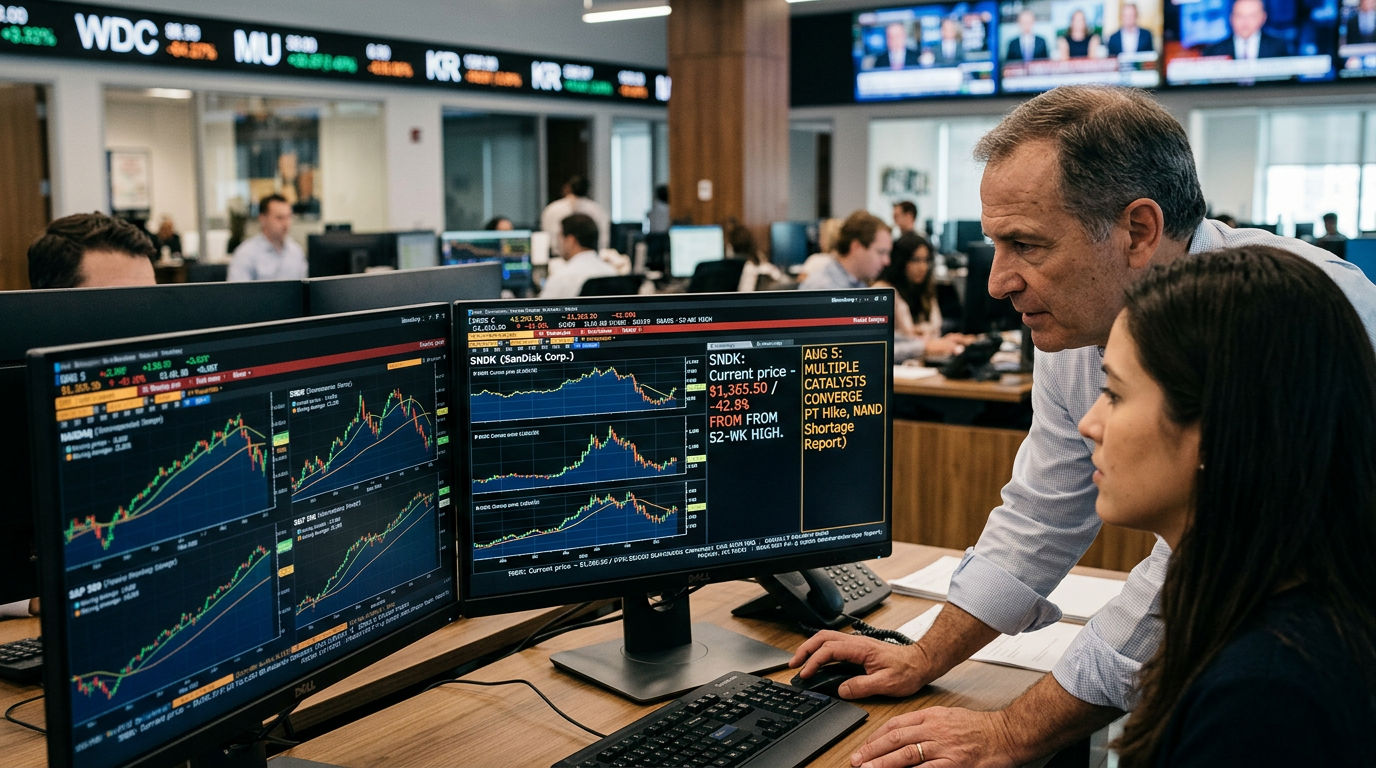
That is the Sandisk (SNDK) question right now. The stock is trading around $1,355 as of July 17, 2026 — roughly 42% below its all-time closing high of $2,335 set in late June. And yet the business underneath that price action reported one of the most extraordinary quarterly results in recent semiconductor history just ten weeks ago. Revenue up 251% year-over-year. Gross margin at 78.4%. EPS of $23.41 against a consensus estimate of $14.36 — a 63% beat. Q4 guidance of $7.75 to $8.25 billion in revenue, with non-GAAP EPS of $30 to $33.
Those are not soft numbers. So why is the stock sitting 42% off its high?
What the Market Believes
The bear case is not complicated, and it is not wrong on its face. Morningstar describes NAND flash as a commodity with high fungibility among chipmakers, arguing that Sandisk lacks an economic moat and is prone to the same boom-bust cyclicality that has defined the memory market for decades. The history is real: periods of tight supply and strong pricing are routinely followed by a glut that compresses margins sharply. The operating leverage that drove earnings up can drive them down just as fast.
The market selloff over the past three weeks has been fueled by something specific: fears that NAND pricing may be peaking. An Evercore analyst made that case publicly on July 15. Argus initiated coverage at Hold, citing elevated risk that demand could moderate. Samsung posted preliminary earnings that disappointed. Korean chip stocks dropped 12% in a single session, and that fear crossed the Pacific within hours. SNDK fell 15% on July 15 alone.
None of that was driven by anything Sandisk did or said. That matters.
July 31: The Gold Market’s Breaking Point
The Iran war isn’t just geopolitical – it’s financial. Within hours, oil surged, defense stocks jumped, and gold ripped past $5,000. Now a July 31st legal deadline could expose the fragile “paper gold” system banks have relied on for decades. When that breaks, gold could surge – but one tiny company sitting on more gold than France, Italy, and China combined could move even faster.
What the Evidence Actually Shows
Here is where the discount gets interesting. Sandisk is not just selling into a shortage at spot prices. Something structurally different is happening in this cycle, and most of the coverage is missing it.
The company has signed five multi-year supply agreements — what management calls New Business Model agreements — covering more than one-third of its fiscal 2027 bit output. Three of those contracts alone carry a minimum total revenue backlog of $42 billion and over $11 billion in enforceable financial guarantees, with terms extending through 2030. These are not letters of intent. They are firm financial commitments disclosed in the April 2026 Form 10-Q, which shows $41.6 billion of transaction price allocated to remaining performance obligations.
Slight tangent, but it matters. Memory stocks have historically traded at compressed multiples because their earnings were assumed to be ephemeral — here in the up-cycle, gone in the down-cycle. The multiple always deflated the moment pricing looked like it might turn. What the NBM agreements do, if they hold, is convert a portion of that spot-priced commodity exposure into something closer to contracted recurring revenue. Not a guarantee. But a meaningful structural difference from every previous NAND up-cycle investors have seen.
The supply side adds additional texture. Goldman Sachs forecasts NAND shortages of 4.4% in 2026 and 4.6% in 2027, with significant new industry capacity not expected until 2028. Global NAND demand is projected to grow 18% year-over-year in both 2026 and 2027, while wafer starts are projected to decline 5% in 2026. The three largest memory producers — Samsung, SK Hynix, and Micron — have shifted production capacity toward high-bandwidth memory for AI accelerators, effectively shrinking the supply available for standard NAND.
The Playbook Every Options Trader Should Have!
Do you dream of retirement but it seems like an impossibility? Wish you knew the best moves to get you there sooner?
It’s closer than you think and you won’t have to work overtime to get it!
Hi! I’m Dave Aquino, expert options trader and my e-book, “How To Master the Retirement Trade” has helped thousands reach their goals!
Follow the link to get your copy and see what you’ve been missing!
Is It Cheap, or Does It Just Look Cheap?
This is the critical question, and it deserves an honest answer rather than a bullish one.
At the current price near $1,355, Sandisk trades at a trailing P/E in the range of 58x and at roughly 8.7x the earnings analysts project for fiscal 2027. On the surface, that looks inexpensive for a company growing this fast. But Seeking Alpha and others have made the countervailing point clearly: deeply cyclical stocks often look the cheapest when they are, in fact, the most expensive — because peak-cycle earnings are being valued as if they are permanent. The question is not whether the Q3 and Q4 earnings are real. They are. The question is whether $30-plus in quarterly EPS is a sustainable run-rate or a peak that will compress when supply conditions normalize.
Goldman’s methodology is worth understanding. The firm raised its price target to $2,200 by applying a 20x multiple to a normalized EPS estimate of $110 — roughly half of what the current cycle is producing in peak quarters. That framing is important. Goldman is not valuing peak earnings; it is valuing through-cycle earnings at a higher-than-historical multiple, and arguing the contracts justify that premium. Whether that argument is correct depends almost entirely on whether the NBM agreements hold as written.
The Cheap Investor Scorecard
- Business Quality: Strong franchise in enterprise SSD and NAND, but pure-play concentration in one memory segment. No confirmed economic moat per Morningstar.
- Financial Strength: Q3 non-GAAP operating margin of 70.9%, free cash flow margin above 50%, $6 billion share buyback authorization. Balance sheet net cash.
- Valuation: ~58x trailing earnings; ~8.7x projected FY2027 EPS. Looks cheap on cycle earnings, expensive if cycle turns.
- Competitive Position: Pure-play NAND gives higher leverage to the storage supercycle than diversified peers like Micron. Also more vulnerable to a reversal.
- Cash Flow: Q3 free cash flow margin above 50% is exceptional. Sustainability is the debate.
- Management Execution: Five NBM agreements signed in roughly six months. Q3 revenue and EPS both beat guidance by substantial margins. Datacenter revenue up 645% year-over-year in Q3.
- Catalyst Strength: August 5 earnings and August 13 investor day provide back-to-back catalysts. LTA disclosure scope is the key variable Goldman flagged.
- Margin of Safety: Limited at current prices if this is a cycle peak. Meaningful if NBM contracts floor the earnings.
- Long-Term Potential: High-bandwidth flash product launches targeted for late 2026 and 2027 could expand addressable market. AI inference demand continues to accelerate.
Bull, Base, and Bear
The bull case: August 5 earnings beat the $33.38 consensus EPS estimate. Management discloses additional LTA agreements, further locking in fiscal 2027 and 2028 revenue. The supply shortage extends as Goldman projects, and the contracted backlog earns a higher multiple than spot-priced memory. The stock works back toward the Goldman target of $2,200.
The base case: Q4 results come in roughly at the guided midpoint. LTA disclosures are incremental, not dramatic. The stock stabilizes in the $1,300 to $1,600 range as investors wait for the fiscal 2027 picture to clarify. Returns from here depend on earnings trajectory over the next two to three quarters.
The bear case: AI memory demand cools faster than anticipated. Chinese competitor YMTC iterates on its technology roadmap, introducing new supply that the market had not priced in. One or more hyperscaler customers pauses or renegotiates contracted commitments. The NBM contracts, which assume the floor holds, become the subject of scrutiny rather than confidence. The stock re-rates toward commodity-cycle math — and the range scenarios here extend toward $1,200 and below.
Hidden in Tesla’s Filing: A $12 Billion “Super Startup”
Pull up Tesla’s most recent SEC filing. Page 5.
And you’ll see a single line showing $12 billion in revenue from a brand-new “super startup” Elon Musk has been quietly incubating inside Tesla.
This new “super startup” has nothing to do with cars or robots or space or AI…
But it sits at the center of what Blackstone calls “a $23 trillion investment opportunity.”
And on July 22, Elon is expected to pull back the curtain and reveal exactly what he’s building.
But Adam O’Dell already knows… and he reveals it all in this urgent video.
What to Watch on August 5
The revenue headline and EPS number will matter less than three other disclosures. First: how many additional NBM agreements, if any, get announced. Second: what management says about pricing trends into the back half of calendar 2026 and into 2027. Third: any commentary on YMTC competitive dynamics or changes in hyperscaler procurement behavior.
Eight days later, on August 13, Sandisk holds its investor day. Goldman specifically flagged that session as the venue where management could quantify the multi-year LTA pipeline and lay out long-term financial targets. For patient investors, the two events together may provide more clarity on whether this discount is a mispricing or a warning.
The honest bottom line: Sandisk is not obviously cheap. It is not obviously expensive. It sits in the genuinely difficult middle, where the answer depends on a structural question — whether multi-year customer contracts can dampen the cyclicality that has defined this business for thirty years — that will not be resolved in a single earnings call. What is clear is that the 42% decline from the June high was driven largely by sector contagion and macro fear, not by anything that changed inside the business. Whether that creates opportunity depends on how much you believe the $42 billion backlog changes the cycle math. That is the work.