
July 15, 2026
Apple Reports July 30. Cook’s Last Call.
The business is in strong shape. The transition is what the market is watching.
First a note from EnergyX
Lithium demand is fueling a modern-day gold rush, set to grow 5X by 2040.
Industries like AI, robotics, and energy depend on it. Microsoft’s CEO even says the AI race will be won on energy costs, not model quality.
That’s creating opportunities for investors. One company, EnergyX, already turned this demand into a $1B unicorn valuation.
EnergyX’s patented tech can recover up to 3X more lithium than traditional methods. That breakthrough earned $150M+ in investments, including from industry leaders like General Motors and POSCO.
Here’s how they’re redefining the $204B energy storage market:
- Disruption: EnergyX’s GET-LiT™ technology recovers lithium from brine at the lowest cost when benchmarked against industry leaders, and it’s protected by 120+ patents.
- Ecosystem: From technology to production resources, EnergyX is building a vertically integrated platform to power the global transition to EVs, backed by investment from leaders like General Motors and Eni.
- Opportunity: Until Thursday, EnergyX is offering everyday investors the chance to join, ahead of full-scale commercialization.
Now they’re ready to unlock commercial lithium production just as experts project demand will grow 5X by 2040. They’ve just commissioned the largest lithium production facility in the U.S. and have the rights to approximately 150,000 acres of lithium-rich land.
FEATURED
Apple Reports July 30. Cook’s Last Call.
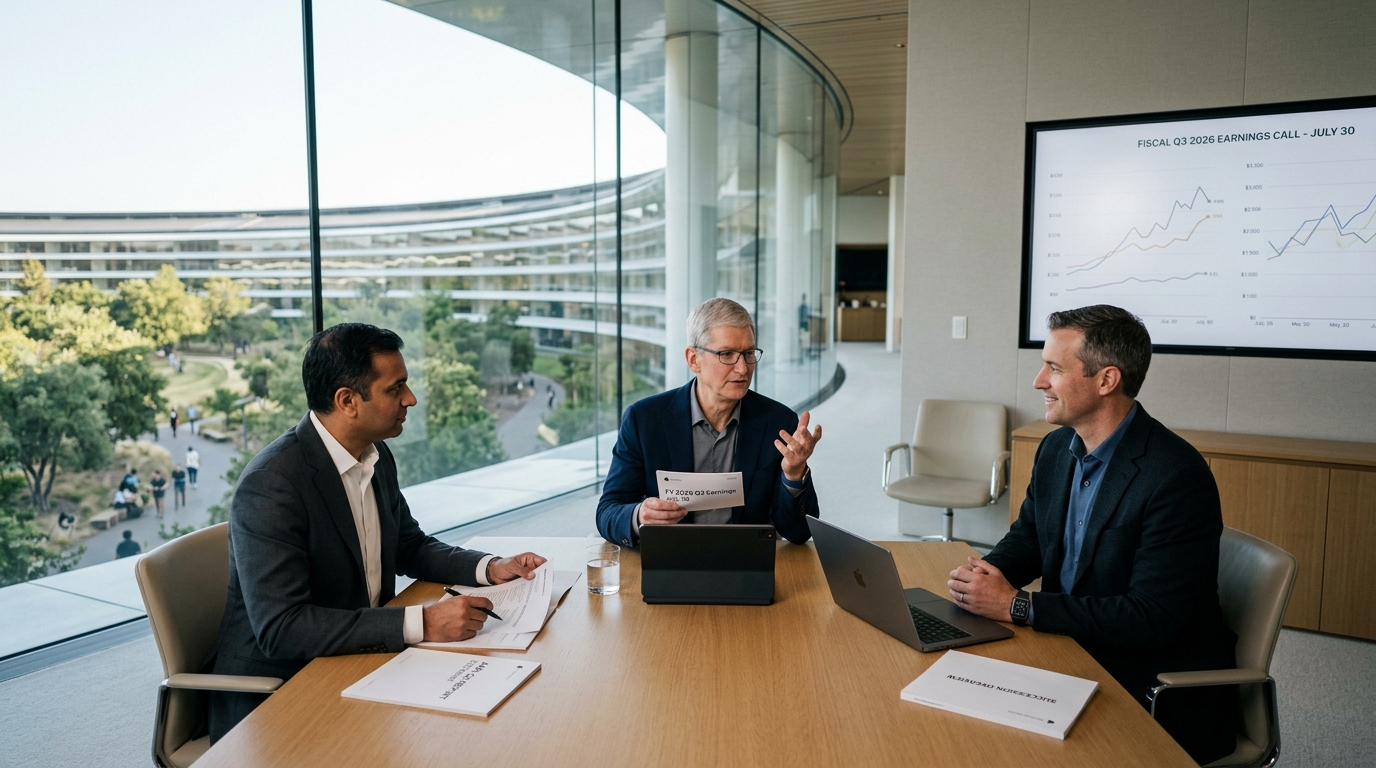
Most quarters, an Apple earnings call is a ritual. Strong numbers, measured guidance, a few pointed questions about China. Then it’s over and everyone moves on. July 30 is different, and it is worth thinking carefully about why.
Tim Cook hosts his final earnings call as CEO on July 30 when Apple reports fiscal Q3 2026 results. CFO Kevan Parekh will be alongside him. Cook transitions to Executive Chairman on September 1, handing the reins to hardware engineering chief John Ternus. The July 30 call sits at an unusual intersection: a financial update, a leadership handoff signal, and a preview of what the Ternus era looks like before it officially begins.
Ternus briefly joined the Q2 call to signal an “incredible roadmap ahead” and to make clear that Cook’s financial discipline would continue under his watch. That was a deliberate message. The question is whether the July 30 call reinforces it.
What the business actually looks like
Apple’s fiscal Q2 2026 was the company’s best March quarter on record. Revenue hit $111.2 billion, up 17% year over year, above the $109.66 billion Wall Street expected. Diluted EPS came in at $2.01, up 22% and ahead of the $1.95 consensus. iPhone revenue reached $57 billion, up 22% from a year earlier. Services hit an all-time high of $30.98 billion, with gross margins of 76.7%. Overall gross margin was 49.3%, up 110 basis points sequentially. Net income was $29.6 billion.
61% of Americans Worry America Could be on the Verge of Another Civil War
Today, more than half of America thinks a civil war is likely.
Former CIA Advisor Jim Rickards agrees.
He just uncovered a fascinating plot by Trump to keep the Democrats out of the White House until 2033.
And while he believes it could be successful, it could also trigger America’s Second Civil War.
The capital return program is equally notable. The board authorized an additional $100 billion share repurchase program and raised the quarterly dividend 4% to $0.27 per share. Apple generated $82.6 billion in operating cash flow in the first six months of fiscal 2026 alone. That is the engine behind the buybacks, the dividend, and whatever comes next.
One more number that does not get enough attention: Apple’s installed base now exceeds 2.5 billion active devices. That is the foundation of everything the Services segment is built on.
What to expect on July 30
Heading into the report, consensus EPS for Q3 sits in the $1.89 to $1.93 range. Revenue consensus is around $108.6 to $110.75 billion. Apple guided for 14% to 17% revenue growth year over year, which already reflected supply constraints tied to memory component costs. For context, that guidance well exceeded the 9.5% growth analysts were expecting when it was issued. The company has beaten Wall Street’s EPS estimate in each of its last four quarters.
Slight tangent, but it matters here: Apple guided Q3 gross margin in the range of 47.5% to 48.5%, down from 49.3% in Q2. The culprit is memory. AI-driven demand for high-bandwidth memory chips has created an industry-wide shortage, and Apple uses significant quantities of LPDDR5X in its higher-end hardware. This is not an Apple-specific problem, but it will show up in the Q3 numbers and will draw questions on the call. Watch how management frames the durability of that headwind.
The market share picture is encouraging. Counterpoint Research data shows Apple captured a record 20% of global smartphone shipments in Q2 2026, even as total industry volumes fell 11% year over year to their lowest level since 2013. Apple held pricing where competitors blinked. That tells you something real about where the brand stands.
The AI angle and what it actually means
Apple is not building a chatbot. The strategy is more patient and, frankly, more interesting than that. Apple Intelligence is being used to push hardware upgrades from users on older devices that cannot run the latest on-device AI models. The installed base of 2.5 billion active devices becomes a multi-year upgrade funnel. If Apple Intelligence accelerates that cycle, hardware revenue climbs and Services attach rates follow.
Services compound faster than hardware and carry gross margins near 77% versus the mid-30s for products. As that mix continues shifting, overall margins expand over time even if any single quarter shows temporary compression from memory costs. Full-year fiscal 2026 EPS consensus is around $8.74, up roughly 17% from fiscal 2025. Fiscal 2027 consensus sits near $9.57.
The bigger story is why nobody saw it coming
On a single trading day, one quantum computing stock jumped 33%.
Another climbed 30%. A third surged 31%.
All three moved on the same funding announcement, within hours of each other.
These gains are not typical and past performance doesn’t guarantee future gains.
But the shocking part?
Most investors watching Nvidia never even saw this sector move.
A small group of traders has a checklist for spotting these setups before the news breaks wide.
There is also a near-term pricing catalyst worth watching. Morgan Stanley analyst Erik Woodring expects Apple to raise the starting price of the iPhone 18 by approximately $200 in September relative to the iPhone 17. He argues that iPhone demand is relatively price-inelastic, meaning Apple can take that price without meaningfully hurting unit volumes. If correct, that adds 2% to 4% to near-term EPS and roughly 1% to fiscal 2027 numbers. Apple also recently announced a multiyear agreement with Broadcom worth more than $30 billion to design and produce custom silicon and wireless connectivity components, with more than 15 billion U.S.-made chips planned as part of the arrangement.
The valuation question
Here is where the honest assessment gets harder. Apple’s current trailing P/E is roughly 38 times earnings, compared to a five-year median closer to 30 times. The stock is trading in the $313 to $317 range, approaching its 52-week high of $323.45. Morgan Stanley has a $360 price target. Monness has $335. The average across roughly 55 analysts sits around $322. Wedbush’s Dan Ives is at $400. And then there is KeyBanc, which downgraded the stock to Underweight with a $250 target, citing slowing iPhone production builds, weak U.S. upgrade trends, and changing device subsidy models.
The premium multiple is not irrational given the Services mix shift and capital return program. But it does mean Apple is priced for continued execution. There is limited room for a stumble. If Services growth slows materially below the mid-teens or if Siri’s AI rollout continues facing delays in key regions, the multiple could compress even if the underlying business remains sound. The App Store is also facing ongoing legal pressure, with Apple seeking Supreme Court review of a contempt ruling over outside-purchase fees. That is not existential, but it is a real overhang.
The Cheap Investor scorecard
- Business quality: Elite. Brand, ecosystem lock-in, and pricing power are among the best in any industry.
- Financial strength: $147 billion in cash and marketable securities. $82.6 billion in operating cash flow in the first half of fiscal 2026 alone.
- Valuation: Premium. Trailing P/E near 38x versus a five-year median around 30x. Not cheap on an absolute basis.
- Competitive position: Record 20% global smartphone share in Q2 2026 while the rest of the industry contracted.
- Cash flow: Among the strongest on the planet. Funds $100 billion buyback programs without stress.
- Management transition: Orderly by design. Ternus is an insider with deep product credibility. The risk is perception, not capability.
- Catalyst strength: iPhone 18 pricing, AI-driven upgrade cycle, and Services mix shift are all real and near-term.
- Margin of safety: Limited at current multiples. Quality is not in question. Price is.
- Near-term risk: Memory cost headwinds, Siri rollout delays, App Store regulatory exposure, and KeyBanc’s bear case on slowing builds.
- Long-term potential: Strong. The installed base of 2.5 billion devices is a durable foundation for a Services-led growth story.
Exxon and Chevron Have an Unlikely New Competitor
Energy giants like Exxon and Chevron are buying land in America’s lithium hotspot. Now they’ve got a new neighbor. EnergyX has now acquired 35k gross acres in Southwest Arkansas, right next door. With tech that can recover 3X more lithium than traditional methods, they’re aiming for America’s lithium crown. General Motors already invested.
Become an early-stage EnergyX investor before Thursday night.
DISCLOSURE: EnergyX’s Regulation A offering has been qualified by the SEC. Before investing, carefully review the offering circular, including the risk factors. The offering circular is available at invest.energyx.com
What actually matters on July 30
Services momentum is the number that moves the multiple. If Services revenue growth holds in the mid-teens or better, the bull case stays intact. If it drifts toward 10%, the premium valuation faces real pressure. iPhone guidance for the September quarter matters too, specifically whether Apple Intelligence is pulling upgrades forward from users on older, non-AI-capable devices. And then there is gross margin. Watch whether management’s commentary on memory costs sounds temporary or structural.
The leadership commentary will matter in a different way. The market does not need Tim Cook to be irreplaceable. It needs to believe the transition is orderly and that the product roadmap is intact. Cook will likely use this call to frame the handover positively. Any signal of disruption gets amplified. Any signal of continuity gets rewarded. Ternus has already started that work on the Q2 call. July 30 is the reinforcement.
The business heading into this report is in excellent shape. The valuation is not a bargain. What is potentially mispriced is the market’s uncertainty about the transition itself. If July 30 goes smoothly and September product launches land well, that discount could close quickly. If something goes wrong with the handoff or the AI roadmap slips further, the premium multiple offers little cushion.
That is the real trade-off here. Not the quarter. The next chapter.