
July 11, 2026
AMD Is Up 155% in 2026
Featured: AMD Is Up 155% in 2026
Below is an important message from one of our highly valued sponsors. Please read it carefully as they have some special information to share with you.
Dear Reader,
When this man warned of the 2008 crisis two years before it ever happened…
The CIA began circulating his warning among its senior staff.
And his full thesis was so in depth that it appeared in the CIA journal “Studies in Intelligence”.

That information remains classified to this day.
Even still, in 2016 when he went on national television to predict the election of Donald Trump…
Most people tried to dismiss him saying that “Hillary is ahead in every poll”…
But events shaped up just the way he said.
Then in 2019, a full 4 months before the coronavirus hit..
He said that a global pandemic could be the cause of the next financial crisis…and that a crisis of this proportion would happen with “near 100% certainty” within the next few years…
Most people thought he finally lost it.
But we all know what happened next…the world was nearly brought to its knees by this “unforeseen” event.
Now this former advisor to the CIA and the Pentagon is issuing a shocking new warning.
One that has to do with the brewing bubble in AI – and an event set to take place just DAYS from now.
If you have money in the markets, or wealth to protect, then you need to heed his warning.
Because once this crisis hits…it will already be too late.
>>> Click Here to See His New Warning <<<
Regards,
Matt Insley
Publisher, Paradigm Press
FEATURED
AMD Is Up 155% in 2026
Everyone is watching Nvidia. That is probably why AMD keeps surprising people.
Shares of Advanced Micro Devices closed July 10 at $557.89, with a market cap touching $900 billion again. The stock is up roughly 155% year-to-date. Goldman Sachs raised its price target to $640 on July 5. Stifel followed on July 10 with its own raise to $635. Both firms kept Buy ratings. Both are making the same core argument: the market is still not pricing the CPU story correctly.
Analyst Targets
- Goldman Sachs: Buy, $640 (raised from $450, July 5, 2026)
- Stifel: Buy, $635 (raised from $450, July 10, 2026)
- Cantor Fitzgerald: $700 (raised from $500, street-high)
- Wells Fargo: Overweight, $615 (raised from $505) – cites EPYC demand strength and pricing upside
The Q1 Foundation
AMD’s Q1 2026 revenue landed at $10.253 billion, up 38% year-over-year, exceeding the high end of guidance. Data Center is now the dominant engine at $5.8 billion, up 57% year-over-year, and for the first time represented more than half of the company’s total revenue. CEO Lisa Su said the results marked a structural shift in AMD’s business, with the Data Center segment now the primary driver of revenue and earnings growth.
Jim Rickards: “This AI Giant is About to Go Bust”
Jim Rickards just released shocking new research predicting this AI giant is about to go bust…
Triggering a full-blown AI meltdown that could wipe out 80% of the stock market.
He says this could be 10 times bigger than Lehman Brothers.
Click here to get the name of this company, completely free of charge…
And learn the five steps he’s recommending you take.
On a non-GAAP basis, EPS came in at $1.37, up 43% year-over-year, beating consensus estimates of $1.27 to $1.29. Free cash flow hit a record $2.57 billion for the quarter. Q2 guidance was set at $11.2 billion in revenue, up roughly 46% year-over-year, with non-GAAP gross margin of approximately 56%. That step from $10.3 billion to $11.2 billion is the first quarter where the next-generation EPYC Venice processor ramp begins contributing more meaningfully.
The Part People Keep Missing
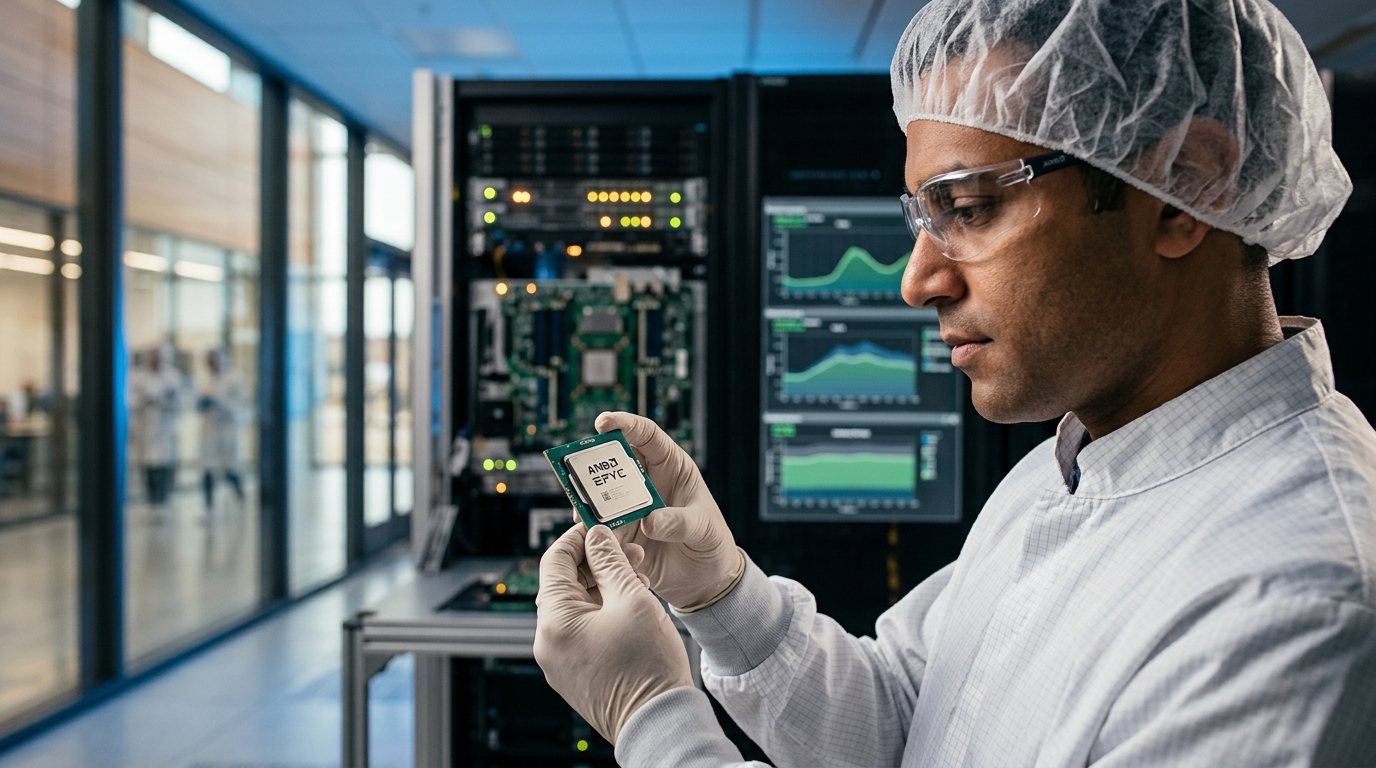
The GPU story gets all the headlines. The Instinct MI series, the Meta and OpenAI deals. But the argument several analysts are now making is a very specific one: the EPYC server CPU is AMD’s most important growth driver over the next two years, not the GPU accelerator.
Here is why that matters. AI model training is GPU-intensive. AI inference, where deployed models respond to real-world queries, requires a mix of CPU and GPU. Agentic AI, where multiple AI systems act autonomously to complete multi-step tasks, requires significant general-purpose compute alongside specialized accelerators. Each step up the AI deployment stack increases CPU demand relative to GPUs. And AMD’s EPYC processors are a key market share gainer in that segment.
AMD passed Intel in quarterly data center revenue for the first time in Q1 2026. AMD also raised its total addressable market estimate for server CPUs to over $120 billion by 2030, reflecting a compound annual growth rate of more than 35%. Wells Fargo models $25 billion in AMD server CPU revenue by 2028 alone. Stifel’s Ruben Roy flagged that management has guided to more than 70% year-over-year growth in Q2 CPU server revenue specifically.
Slight tangent, but it matters: the EPYC Venice processor, built on TSMC’s 2nm process, began a production ramp in late May, with volume scaling expected through the second half of 2026. AMD noted that more customers are validating Venice than any prior EPYC generation. The follow-on Verano platform, targeting 2027, focuses on AI performance per dollar per watt. The roadmap here is unusually clear for a chip company mid-cycle.
Two Dates That Matter
The first one is July 23. AMD is hosting its Advancing AI 2026 event, and Stifel’s Roy specifically flagged it as a potential catalyst ahead of earnings, particularly around MI450 ramp commentary and Venice validation updates. The second date is August 4. That is when Q2 earnings drop.
The market is expecting around $11.2 billion in revenue at the midpoint of AMD’s own guidance. Named catalysts already on the books include a 6-gigawatt OpenAI GPU deployment commitment and a matching 6 GW Meta commitment on MI450. The semiconductor industry enters this earnings season with real momentum: according to FactSet’s Earnings Insight report dated July 2, 2026, the Semiconductors and Semiconductor Equipment industry is projected to deliver 131% year-over-year earnings growth in Q2 2026, making it the single biggest driver of the Information Technology sector’s expected 63.3% earnings growth. AMD sits at the center of that wave.
Not Your Typical $5 Stocks. These 5 Stand Apart
Most low-priced stocks are driven by hype, momentum, or speculation.
This list is different. These five Nasdaq companies are operating in real, growing industries like AI and autonomous tech. They are earlier-stage, but not random. That is exactly what makes them worth a closer look right now.
Forward Scenarios
Bull: Q2 revenue comes in at or above $11.5B, Data Center re-accelerates above 60% growth, Venice ramp commentary is specific and bullish at the July 23 event. Stock moves toward the $640 Goldman target and Cantor’s $700 becomes the new anchor. Agentic AI adoption gives the CPU argument a multi-year duration.
Base: Q2 lands near the $11.2B midpoint, margins hold at 56%, Instinct GPU demand stays firm. Stock consolidates in the $520 to $600 range as investors wait for Venice volume data in Q3. No major downside, but the next leg higher requires GPU demand to accelerate in H2.
Bear: The chip sector sell-off deepens before August 4, hyperscaler capital spending guidance disappoints across the board, and AMD’s premium multiple compresses. The stock pulled back over 8% in the sector sell-off the week of July 7. Export control uncertainty around China remains a live risk that could hit guidance at any point.
Technical Overlay
AMD held above its 200-period EMA during the sector sell-off, which matters. The 52-week high is $584.73, reached on June 30. The stock closed July 10 at $557.89, roughly 4.5% below that level. A sustained move back above $570 opens a path toward the prior high. Lose $497 on a close and the 200-period EMA becomes the next real test.
The Honest Read
AMD’s valuation is not cheap. The stock trades at a significant premium to historical norms, priced for near-perfect execution. Goldman’s $640 target implies the market is still underpricing the CPU ramp. Cantor’s $700 requires earnings to compound at a rate that would make the current multiple look reasonable in hindsight.
The range from $460 to $700 in analyst targets is a genuine disagreement about how far and how fast the CPU story goes. That disagreement is exactly what creates the opportunity. When most investors are still calling AMD a GPU story, and the real driver turns out to be EPYC, the rerating can be significant.
July 23 and August 4 are the next data points. Watch the Data Center segment number more than total revenue. And watch what Lisa Su says about Venice validation in Q3 more than anything else. That is the variable analysts are actually arguing about.