May 20, 2026
SpaceX Is Going Public.
The largest IPO in history could land June 12 — and the fine print is more complicated than the hype suggests.
First a note from Brownstone Research
Editor’s Note: What if you could claim a stake in what’s set to be the biggest IPO ever… starting with just $500? Click here to see the details from former tech executive and angel investor Jeff Brown – the man who picked Bitcoin, Tesla, and Nvidia before they exploded higher. Or read more below.
Dear Reader,
Elon Musk just unlocked the biggest investment opportunity of the year.
He’s about to take SpaceX public in what’s set to be the biggest IPO ever.
The New York Times predicted it “will unleash gushers of cash for Silicon Valley and Wall Street.”
If you click here and learn what to do…
Some of that cash could end up in your pocket.
ATTENTION: There’s no need to wait for the company to go public.
You can claim your stake today.
But hurry…
Elon Musk has already interviewed the Wall Street banks that will file all the paperwork and take the company public.
And he has already announced his IPO plans to his shareholders…
Confirming that it will happen soon…
I believe he’ll file the paperwork by the end of this month…
That’s why I’m urging you to click here and learn how to claim your stake now.
Look, this might be the most anticipated IPO in the history of mankind.
Once the company goes public, for the first time ever…
Hundreds of millions of investors around the world…
Will have a chance to buy shares of one of Elon’s most successful companies.
I believe it’s going to be a stampede like we’ve never seen before.
But you can get ahead of the crowd.
Just click here and I’ll show you how to get started.
We have so much to look forward to,
Jeff Brown
Founder & CEO, Brownstone Research
FEATURED
The public S-1 was targeted for today — May 20 — the same afternoon Nvidia reports earnings. Two of the most watched events in recent market memory, possibly landing within hours of each other. As of this writing, the prospectus has not yet appeared on SEC EDGAR. But with a roadshow reportedly scheduled to begin June 4, it has to drop soon. The clock is running.
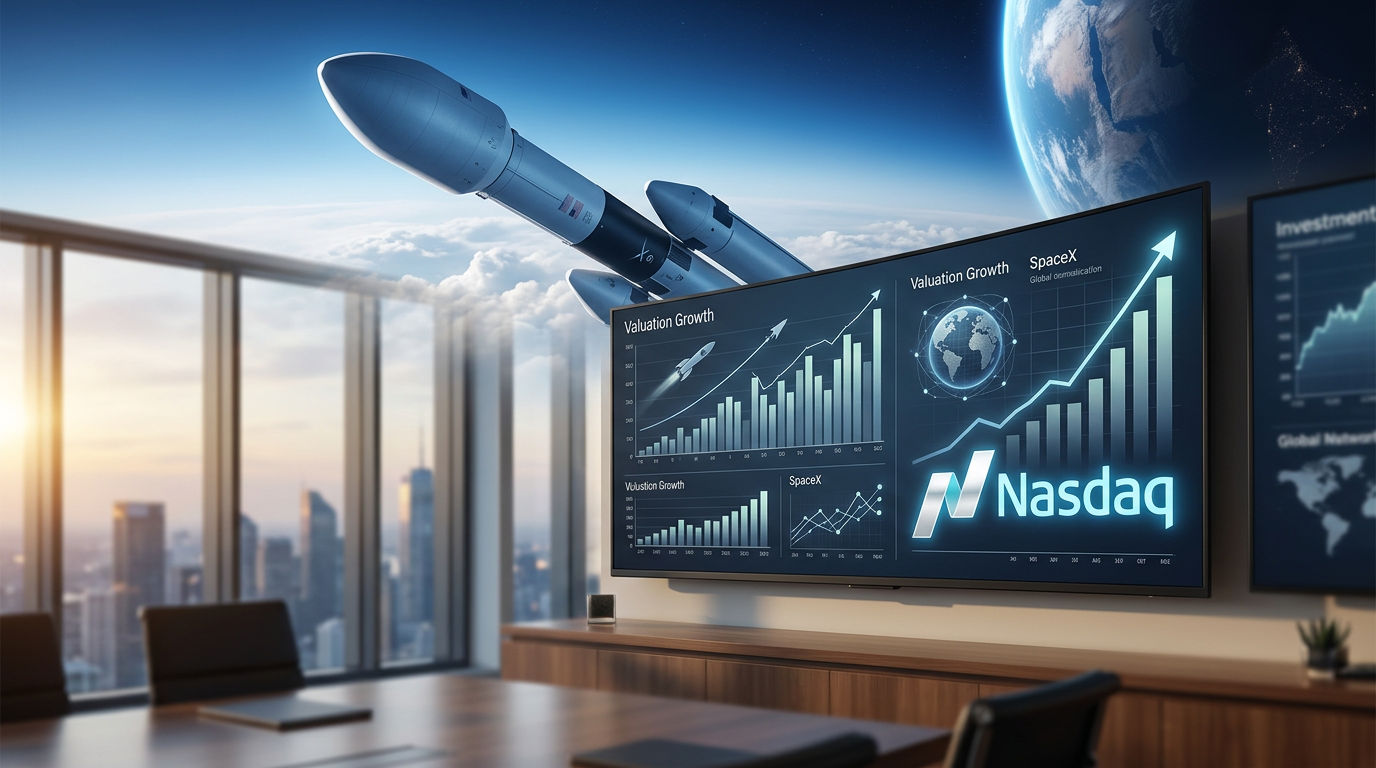
Here’s what’s confirmed versus what’s still reported. SpaceX is targeting a June 12 Nasdaq debut under the ticker SPCX — though the ticker remains technically unconfirmed until the public filing lands. The company is seeking to raise approximately $75 billion at a valuation of $1.75 trillion or more, which would shatter the all-time IPO record. Saudi Aramco’s 2019 debut raised $29.4 billion. SpaceX is aiming for more than double that raise, at a valuation more than five times larger. Bloomberg reported within 24 hours of the April 1 confidential filing that the internal target had already moved above $2 trillion.
The Business Behind the Number
SpaceX isn’t one business — it’s closer to three, packaged together. There’s the launch business, which controlled roughly 82% of global commercial launches in 2025. There’s Starlink, which surpassed 10 million active customers across 160 countries by February 2026. And now there’s an AI infrastructure layer, after SpaceX completed the acquisition of Elon Musk’s xAI in an all-stock deal in February 2026.
On the revenue side, total SpaceX 2025 revenue landed at approximately $15–$16 billion. Starlink was responsible for $11.4 billion of that — up 50% year-over-year — with an EBITDA margin of 63%. The launch business contributed roughly $4.1 billion, with revenue growth slowing to around 8% in 2025. xAI, the newest piece, burned $9.5 billion in the first three quarters of 2025 while generating only $210 million in revenue over the same period. That divergence matters for how the valuation is built.
Slight tangent worth noting: SpaceX has also announced Terafab, a semiconductor manufacturing joint venture between SpaceX, Tesla, xAI, and Intel. The first-phase cost is projected at $55 billion, with a full buildout potentially reaching $119 billion according to CNBC. The facility targets 2-nanometer chip production for orbital AI satellites, Tesla’s autonomous vehicle systems, and xAI’s Grok models. Small-batch production is targeted for 2026, though Morgan Stanley has estimated initial chip output won’t occur until mid-2028 at the earliest. That’s the ambition. The execution risk is real.
Iran War Shock: What I Was Told In That Private Meeting
On January 7th… just outside Washington, D.C… I sat across from a man whose family has been tied to global power for decades.
Oil deals. Intelligence circles. Government insiders.
He leaned in and told me something that changed everything I thought I knew about the Iran war.
What you’re seeing on the news? It’s not the real story.
The strikes… the chaos… the escalation…It’s all part of something much bigger.
And the only reason I know this is because of him – an anonymous contact who risked everything to pass this information along.
What the Valuation Actually Implies
At $1.75 trillion, SPCX would trade at roughly 109–116 times trailing 2025 revenues. That’s a multiple that demands near-flawless execution — for years, not quarters. The forward model only works if Starlink keeps scaling, Starship achieves commercial reusability, and the xAI integration eventually generates real revenue. Three things that all have to go right, more or less simultaneously.
PitchBook values SpaceX at roughly 95 times 2025 revenue, with a fair-value range of $1.1–$1.7 trillion. Morningstar has called the $1.5 trillion target “expensive and risky, but not irrational.” NYU finance professor Aswath Damodaran projects an intrinsic value closer to $1.22 trillion, suggesting the IPO price carries a meaningful growth premium above his base case. None of those figures are wrong. They’re just different views on how much you’re willing to pay for what might happen.
Worth knowing before the roadshow kicks off: SpaceX has reportedly notified shareholders of a 5-for-1 stock split ahead of the IPO, which would reduce the estimated per-share price from roughly $526 to around $105. That’s about accessibility for retail buyers, not about value.
BlackRock is reportedly in advanced discussions to invest $5–10 billion as an anchor investor, drawing from its $536 billion in actively managed funds. That’s institutional weight behind the offering — but it doesn’t change the math on the revenue multiple.
The Risks Investors Are Underweighting
Governance is the one that keeps coming up. A May 4 federal filing pegged Musk’s economic stake at 42.5% and his voting control at 83.8%. The dual-class structure gives insiders Class B shares carrying 10 votes each, versus the single vote attached to Class A shares sold to the public. Public shareholders get an economic stake but effectively no meaningful ability to influence board decisions, challenge management, or replace directors.
It goes further than typical dual-class structures. SpaceX’s bylaws will require shareholders to waive jury trial rights. Class actions against the company, its directors, and IPO bankers are off the table. Disputes go through mandatory arbitration. SpaceX itself flagged this in its risk disclosures, telling prospective buyers they “will not have the same protections afforded to shareholders of companies that are subject to all of the corporate governance requirements.” Major U.S. pension systems — including those from New York and California — have already pushed back in writing.
Retail investors reportedly get up to 30% of the IPO allocation — roughly three times the standard for a deal this size. That’s unusual. First-day volatility in an offering this large, with this much pre-IPO momentum, is essentially a given.
And then there’s Starship. SpaceX flew 5 Starship test flights in 2025 against a stated target of 25 — a fivefold miss. The entire forward valuation model for the launch business depends on Starship reaching commercial reusability. That hasn’t happened yet.
The Ripple Effect on Space Stocks
This IPO doesn’t just affect SPCX. Once listed, SpaceX becomes the valuation anchor for the entire low-Earth orbit sector. Rocket Lab (RKLB) posted Q1 2026 record revenue of $200.3 million, up 63.5% year-over-year, with a $2.2 billion backlog — and has been described by analysts as “the most direct publicly traded alternative to SpaceX.” Redwire (RDW) is also seen as a potential sentiment beneficiary.
AST SpaceMobile (ASTS) is the more complicated call. The company reported only $14.7 million in Q1 2026 revenue and has guided for $150–$200 million for full-year 2026. Its market cap near $22 billion implies a forward price-to-sales ratio well above 100x. Once SpaceX trades publicly with real, audited financials, investors will have a genuine comparator for the first time. That pressure will land somewhere.
A successful SpaceX debut could accelerate a broader wave of high-profile listings. Anthropic has already been discussed in that context.
The right posture here isn’t excitement or avoidance. It’s preparation. Read the S-1 when it lands. Separate Starlink economics from launch revenue. Understand the Starship execution risk. Look at the xAI burn rate. Model the dilution. Then decide.
Great company. Complicated entry point.
Those two things can both be true.
For informational purposes only.