

May 19, 2026
Elon Says AI Will Replace Jobs. This Company Built the Solution.
Featured: Seagate Just Had a Bad Monday
A note from Mode Mobile
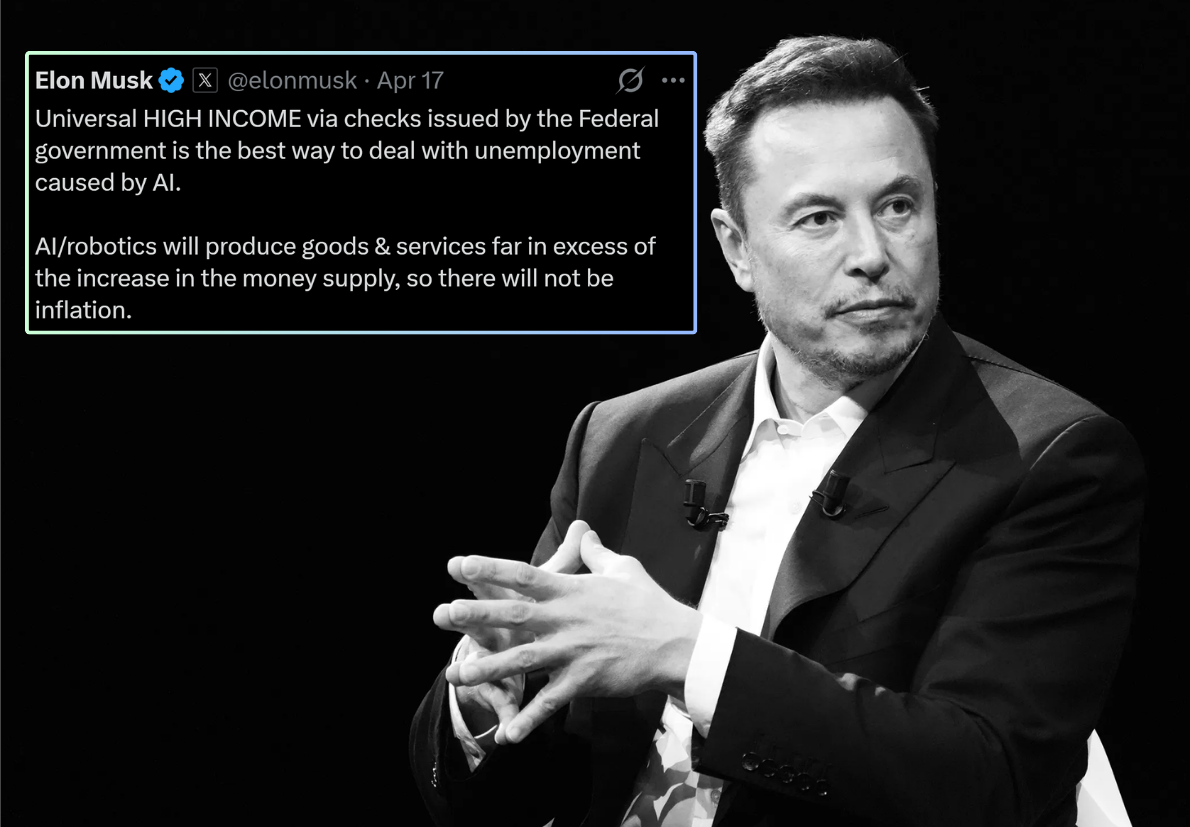
Elon Musk’s latest statement wasn’t subtle.
AI could force governments to introduce universal income.
That’s the future most people are preparing for.
Mode Mobile is already there.
While others debate policy, Mode is already scaling a platform that turns attention into earnings.
They’ve built a system where your phone generates income daily.
Browsing. Listening. Charging. Using apps.
Those same 5 hours people spend on their phones every day… now monetized.
And the traction is hard to ignore:
- 490M+ users globally
- $1B+ earned and saved by users
- $115M+ revenue
- 32,481% growth (#1 fastest-growing software company by Deloitte)
This isn’t a concept.
It’s a working economic model.
Just like Uber turned cars into taxis and Airbnb turned homes into hotels, Mode is turning smartphones into EarnPhones.
And investors can still access pre-IPO shares in this category disruptor at just $0.50.
But that window won’t stay open forever.
With a Nasdaq ticker secured ($MODE), the company is positioning for a potential IPO in the near future.
Get in before the public markets catch up.

Seagate Just Had a Bad Monday
Seagate Technology (STX) dropped 7.5% on May 18 and the company did not release a single new filing. No earnings report. No guidance revision. No analyst downgrade. Just CEO Dave Mosley on a conference stage at the JPMorgan Global Technology, Media and Communications Conference, answering a question about factory expansion. His answer was three words: “take too long.” That was enough. Shares slid from roughly $795 down toward $736 by the close, reversing a good chunk of a rally that had taken the stock from around $411 in February to an all-time high of $841.31 just seven days earlier on May 11. The selloff came entirely on the back of Mosley’s remarks, with the broader tech sector also under pressure, declining 1.62% on the same session.
Worth slowing down on what Mosley actually said.
He was not signaling demand trouble. When pressed on whether Seagate would build new factories to keep pace with AI-driven storage demand, Mosley explained that diverting engineering teams toward new facilities would slow the company’s rate of technology advancement. Any new capacity, he said, would risk arriving after the demand curve it was built to serve. The company’s answer to the demand gap is not more square footage. It is areal density. Seagate is pushing growth through technology transitions, moving from roughly 3 terabytes per platter toward 4 and eventually 5 under its Mozaic 3 HAMR platform. That platform has now completed qualification at all planned cloud service providers. The 50% exabyte crossover to HAMR is expected in the second half of calendar 2026. Recording head wafers carry lead times exceeding nine months, with finished drives taking an additional quarter. The company shifted to a build-to-order model with demand visibility four to five quarters out. That is a more capital-efficient path. It is also a narrower one than some investors had assumed.
The underlying business numbers are not the problem here.
Q3 fiscal 2026, reported April 29, produced $3.11 billion in revenue, up 44% year-over-year and 10% sequentially, beating analyst estimates of roughly $2.96 billion. Non-GAAP EPS came in at $4.10, up 115% year-over-year, against analyst expectations of approximately $3.26 to $3.51. GAAP gross margin hit a record 46.5%. Free cash flow reached $953 million, described by management as a decade-high, with operating cash flow of $1.1 billion. The company retired $641 million in debt during the quarter and returned $191 million to shareholders through dividends and repurchases. Q4 fiscal 2026 guidance calls for $3.45 billion in revenue, plus or minus $100 million, with non-GAAP EPS of $5.00, plus or minus $0.20. Full-year fiscal 2025 revenue was $9.10 billion, up 39% from $6.55 billion the prior year, with earnings up 339%. These are not the numbers of a company in trouble.
Everyone’s Watching SpaceX. Few Are Watching This.
The expected SpaceX IPO has reignited interest in the space economy – and for good reason. It could become one of the largest public offerings in history.
But experienced investors have seen this pattern before. During railroads, oil booms, and the rise of the internet, the biggest long-term winners weren’t always the headline names. They were the infrastructure companies that made expansion possible.
Today, the space industry faces real bottlenecks that giant rockets alone don’t solve: testing capacity, scheduling constraints, and access to orbit.
A small, operational aerospace company is positioning quietly at that intersection.
See who’s supporting the next phase of the space economy – behind the scenes.
The broader macro was not helping on Monday. The 10-year Treasury yield climbed to roughly 4.63%, adding pressure across high-multiple growth names. STX was not falling in isolation.
The part people skip is the valuation math. At its pre-drop price, STX carried a trailing P/E of roughly 74x, according to Yahoo Finance, representing a significant premium to the sector. Analyst consensus across sources shows a majority Buy rating, with Ticker Nerd aggregating 38 analysts at 20 Buy, 4 Hold, and 0 Sell, and a median 12-month price target of $771. StockAnalysis shows 24 analysts with an average target of $814.95. The targets spread widely, from $545 on the low end to $1,000 on the high end. Evercore ISI raised its target to $1,000 from $750 on May 12, just six days before the drop, maintaining an Outperform rating and citing disciplined supply management, continued technology advancements, and what the firm called a “robust” demand environment. Worth noting separately: insiders sold $66.4 million in stock over the past three months with zero recorded purchases in the same window. Executives sell for many reasons, and this alone means little. But layered on top of a GuruFocus GF Value of $153.33 against a then-current price of $721, flagging the stock as 370% overvalued by that model, the multiple is asking a lot of the execution ahead.
What’s interesting is that Mosley did not change the growth target. He confirmed it. Mid-20s percent CAGR, driven by technology transitions rather than capacity additions. The strategy is deliberate, capital-efficient, and broadly supported on Wall Street. The question Monday raised is not whether Seagate can grow. It is whether some investors had priced in a version of the company that was physically bigger, with more factories and more raw output, and whether that version was ever real. That gap between what some buyers assumed and what management actually intends is what got corrected on Monday. Whether that is a one-session adjustment or the beginning of a longer recalibration is the question still sitting open.
That answer is not obvious yet.