
May 9, 2026
Rocket Lab’s 34% rip wasn’t random
Why RKLB suddenly looks less like a “space stock” and more like infrastructure
RKLB up 34.3% and at new highs isn’t just “a stock moving.” It’s a signal about what investors want to own in 2026 when they’re done playing hot potato with ideas and start paying up for things that are hard to replace.
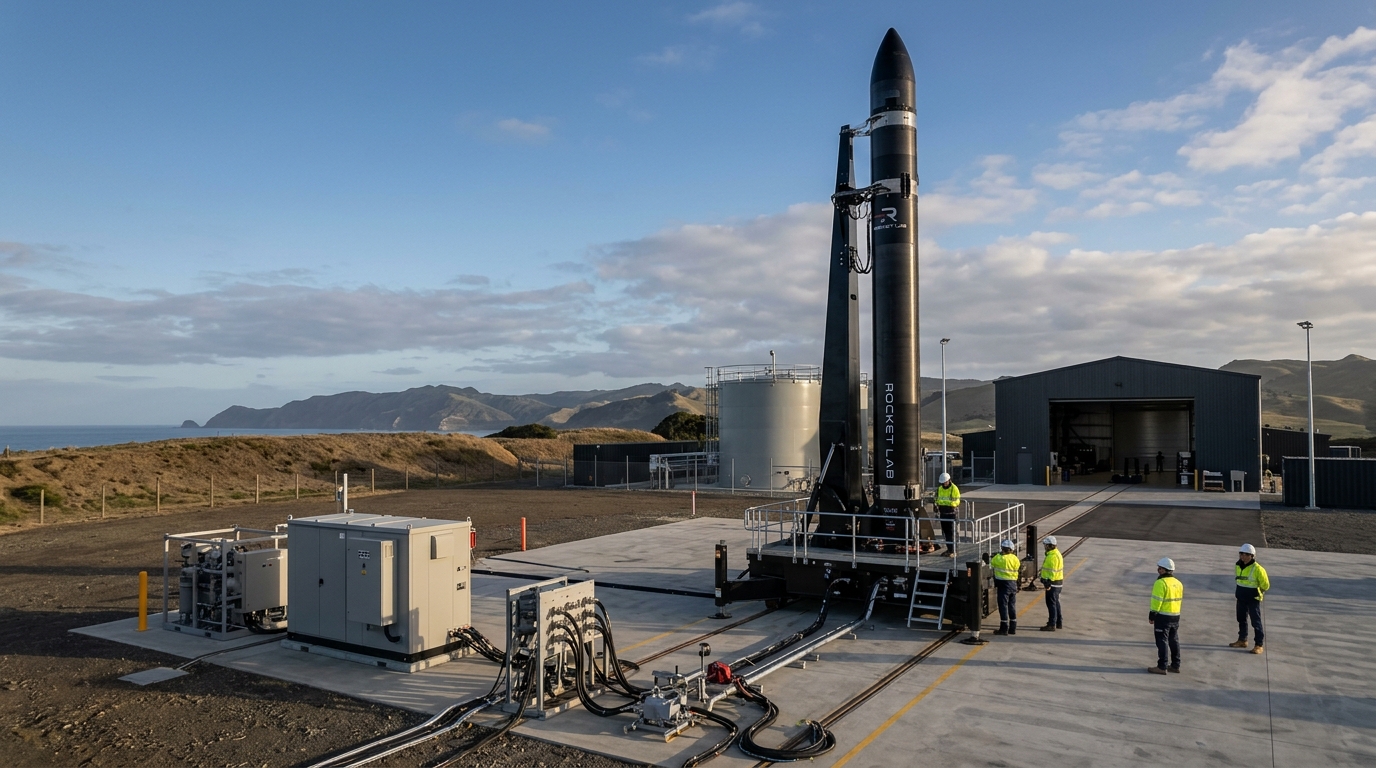
Rocket Lab is getting treated less like a speculative space name and more like infrastructure: the unglamorous picks-and-shovels layer that governments, primes, and constellations can’t easily swap out once they commit. That distinction sounds academic until you watch how capital behaves on days like this. Money doesn’t chase “cool.” It chases inevitability. Or at least, it chases the closest thing to inevitability it can find.
Why a 34% day matters (and why it happened now)
A move like +34.3% tends to get explained with one word: “earnings.” Or “contracts.” Or “momentum.”
But big one-day moves are usually a crowded hallway moment. Everyone is trying to walk through the same door at the same time, because the door just got wider.
What’s verifiable from Rocket Lab’s own disclosures: on May 7, 2026, the company reported first-quarter 2026 financial results and described the quarter as surpassing all guidance metrics, including record quarterly revenue of $200M+ and total backlog above $2B.
- Q1 2026 revenue: $200.3M (record quarter per company release)
- Total backlog: “over $2 billion” (company release)
That kind of update matters because it changes what investors think they’re buying: not a single product, but a platform with more visible demand.
[Urgent] Starlink Set For The Largest IPO In History?
He turned PayPal from a tiny, off-the-radar startup to a massive $64 billion giant.
Then, he did it again with Tesla, which is up more than 19,500% since 2010.
For perspective, that turns $100 invested into almost $20,000!
And now, Elon could be set to do it for the third and final time with what might be his biggest breakthrough yet.
And for the first time ever, you have the rare chance to profit BEFORE the upcoming IPO.
The pivot: from “space theme” to “space infrastructure”
Space “themes” come and go. Infrastructure doesn’t. Infrastructure compounds quietly, wins procurement battles, and turns relationships into pipelines. It’s also the kind of business where switching costs are real – not because a contract says so, but because the engineering, qualification, timelines, and trust make change expensive.
Rocket Lab has been building toward that kind of defensibility with a strategy that looks boring on a slide and powerful in reality: vertical integration and mission relevance.
If you only think of Rocket Lab as “the Electron company,” you’re missing what investors are paying for now: the capability map.
- Launch: Rocket Lab markets Electron as dedicated access to space for small satellites.
- Hypersonic testing: Rocket Lab has positioned HASTE (a suborbital variant derived from Electron) as a hypersonic test launch capability for government and allied customers.
- Space systems: The company describes itself as a provider of launch services and space systems (spacecraft components and related solutions), which supports the “infrastructure layer” framing.
That’s the infrastructure framing: a company that can support many missions even when it’s not the “headline” contractor.
Slight tangent, but it matters: investors love to say they want “picks and shovels.” Then they spend years avoiding them because they’re not flashy. Until the day the market decides the shovel company is actually the scarce asset.
What high-conviction infrastructure investors look for
When investors pivot into “high-conviction infrastructure,” they’re basically looking for businesses with:
- Long-duration demand that doesn’t disappear when budgets tighten or when the macro mood shifts.
- Customer gravity (often defense/civil space) where repeat tasking is plausible.
- Execution culture where timelines and quality control are treated like existential issues.
- System-level moat: you’re embedded across multiple parts of the mission, not just one widget.
Rocket Lab’s disclosures and coverage support the view that hypersonics demand is real and growing. For example, in March 2026 Rocket Lab announced a $190M contract for 20 HASTE launches under the MACH-TB 2.0 hypersonic test program, described by Rocket Lab as its single largest launch contract and as pushing total backlog above $2B.
But let’s not kid ourselves: the risks are still there
A stock doesn’t go +34% in a day because risk vanished. It goes +34% because buyers decided the upside is worth carrying the risk.
The uncomfortable truth: infrastructure stories can be fragile when expectations get too clean. If the market starts assuming flawless execution, the tolerance for delays, cost creep, or one ugly quarter gets razor thin.
Three risk buckets matter here:
- Execution risk: rockets, manufacturing, and defense programs punish complacency. Timelines slip. Suppliers miss. Testing uncovers issues at the worst time.
- Concentration and lumpiness: defense work can be sticky, but revenue timing can be uneven because awards, options, and mission schedules don’t land smoothly each quarter.
- Valuation risk: when a stock is at highs after a huge gap, the next few months can become less about “is the company good?” and more about “did we already pay for the next two years?”
This is where investors get sloppy. They confuse a great company with a great buy at any price. Those are different conversations.
Wall Street is Sleeping on Elon’s New “Super Startup”
This new “super startup” has nothing to do with cars or robots or space or AI…
But it sits at the center of what Blackstone calls “a $23 trillion investment opportunity.”
And on July 22, Elon is expected to pull back the curtain and reveal exactly what he’s building.
But Adam O’Dell already knows… And he reveals it all in this urgent briefing.
As you’ll see, the investors who position themselves before this becomes front-page news could walk away wealthier than they ever thought possible.
Go here to watch the full briefing now –
And get one of Adam’s top picks to play it completely free.
What I’m watching next
If you want to treat Rocket Lab like infrastructure, you watch it like infrastructure. Not week to week. Quarter to quarter, program by program.
- Backlog quality: does backlog keep growing, and does it convert to revenue in line with company guidance?
- Margins and throughput: can they scale manufacturing and launches without quality slipping?
- Hypersonics cadence: do HASTE awards and missions expand beyond one-off test campaigns into repeat demand?
- Next vehicle milestones: progress on Neutron remains a key long-term swing factor, even if the rest of the business is strengthening.
One more thing: watch the tone of the investor base. When a stock starts attracting “this is a core holding” money, pullbacks get bought differently. They feel different. Less panic, more patience. That’s when the stock stops being a trading vehicle and starts being a portfolio position.
Bottom line
RKLB at new highs after +34.3% is the market saying something pretty simple: investors are increasingly willing to pay up for builders with real mission relevance, recurring demand, and a widening capability stack.
What’s confirmed is the fundamental backdrop – Rocket Lab reported Q1 2026 revenue of $200.3M and total backlog above $2B, and separately announced a $190M hypersonics contract for 20 HASTE launches under MACH-TB 2.0 in March 2026. What you should verify against the price chart is the exact session tied to the +34.3% move and whether “new highs” refers to all-time or 52-week highs.
That doesn’t mean the stock is “safe.” It means it’s graduating into a category where capital sticks around longer – as long as execution stays tight.
And that’s the whole game now. Deliver. Keep delivering. Then deliver again.
– The Cheap Investor