
May 1, 2026
The Industrial Alibi: XOM and CVX Just Proved the Fortress Hedge Works
Guyana records, $15.6B in structural savings, and $15B returned to shareholders. The Middle East is loud. The Permian doesn’t care.
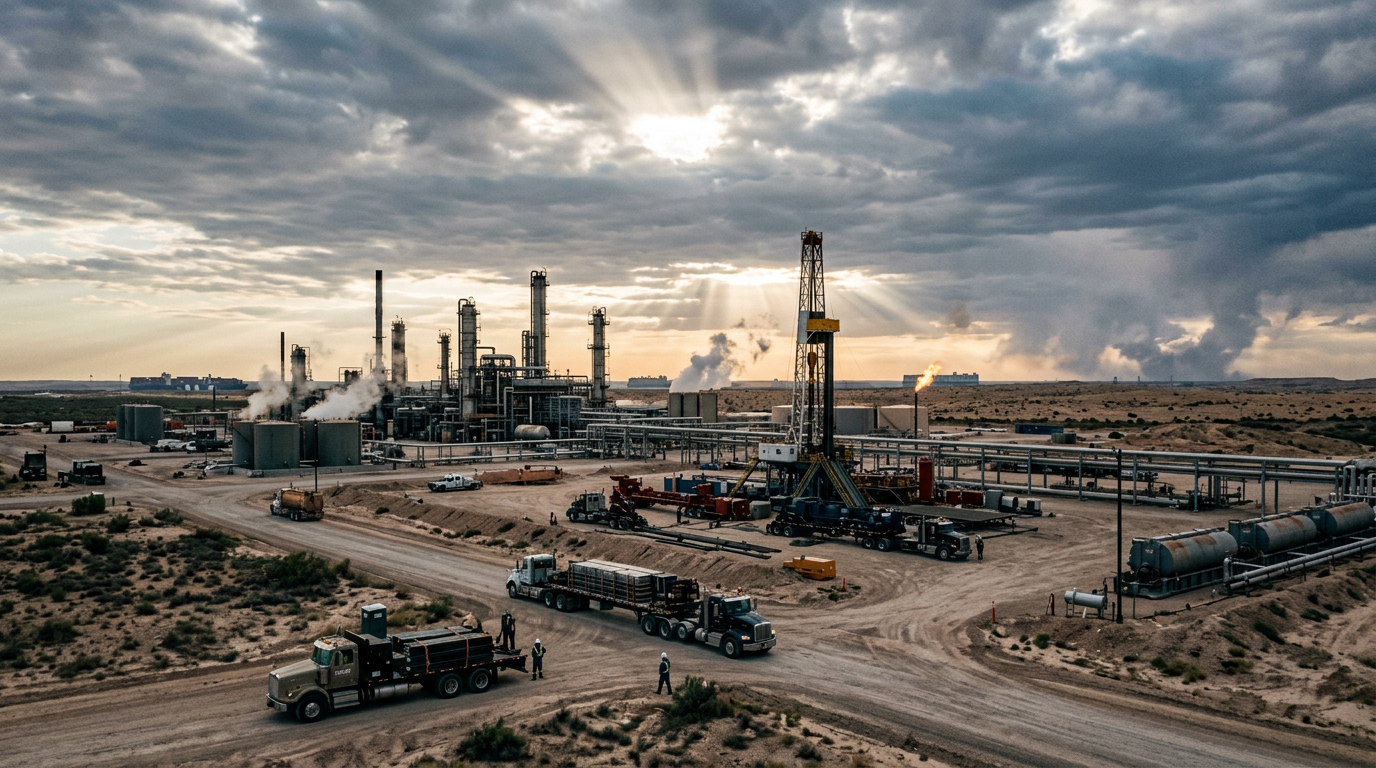
This morning, while the rest of the market was still parsing Apple’s guidance and refreshing their Fed feeds, two of the largest energy companies on the planet dropped results that the consensus had already written off. Exxon and Chevron both beat. Not barely – beat by enough to matter.
Here’s where I’m at on this: the headline net income numbers look ugly at first glance. They always do when derivatives are misfiring and geopolitical noise is cramming itself into the accounting. But the adjusted picture – the one that strips out timing effects and one-time legal reserves – tells a completely different story. And that story is the one worth owning.
The Numbers
ExxonMobil (XOM)
- Adjusted EPS: $1.16 vs. $1.07 expected
- Revenue: $85.3B vs. $81.5B expected
- Net Income: $4.2B (vs. $7.7B in Q1 2025)
- Shareholder Returns: $9.2B, including $4.9B in buybacks
Chevron (CVX)
- Adjusted EPS: $1.41 vs. $0.92 expected
- Revenue: $48.6B vs. $47.4B expected
- Net Income: $2.2B (vs. $3.5B in Q1 2025)
- Shareholder Returns: $6.0B — 16th straight quarter above $5B
Combined, that’s roughly $15.2 billion returned to shareholders in a single quarter. While the Hormuz blockade is sending derivatives haywire and the tape on crude looks like a cardiac monitor.
In by 9:35 AM. Out by 10.
Forget mythical strategies and screen time that eats your whole day. One morning setup has been quietly delivering triple-digit wins to traders who know where to look. The Opening Bell Trade Guide shows you exactly how it works and right now you can grab it at zero cost.
What Actually Happened – and Why the GAAP Number Is a Distraction
Both companies took massive hits from derivative timing effects. For Exxon, the mismatch between mark-to-market financial derivatives and the physical delivery of associated transactions alone clocked in at roughly $3.9 billion in unfavorable timing effects. Strip that out, and upstream earnings ex-identified items reached $6.3 billion, supported by record Guyana volumes and continued Permian growth. Chevron’s story is nearly identical – reported earnings were slammed by approximately $2.9 billion in unfavorable downstream timing effects, plus a $360 million legal reserve charge. Adjusted earnings came in at $2.8 billion, or $1.41 per diluted share.
The part people skip: these are non-cash, accounting-driven effects that reverse. They’re not operational deterioration. They’re what happens when physical crude prices spike faster than financial hedges can catch up. It looks terrible on a GAAP basis. It tells you almost nothing about the underlying production machine.
And that production machine is what matters right now.
Guyana Is Running. The Permian Doesn’t Stop.
Exxon set a new quarterly production record in Guyana – more than 900 thousand gross barrels of oil per day. That’s not a rounding error. Guyana, alongside the Permian, is what Exxon calls its “advantaged asset” base. Total net production hit 4.6 million oil-equivalent barrels per day in Q1. And then there’s Golden Pass LNG Train 1, which achieved first production in March – adding roughly 5% to U.S. LNG export capacity in a single quarter.
Slight tangent, but it matters: the LNG piece is underappreciated in the current Middle East framing. Everyone’s focused on the Hormuz blockade and crude derivatives. What they’re missing is that Exxon quietly expanded its natural gas export infrastructure at exactly the right moment. Europe is still hungry. Asia remains structurally short. Golden Pass is not a side story.
For Chevron, U.S. refineries reportedly operated at record crude throughput in March. Permian production continues tracking toward the 1 million BOE/day milestone that management flagged in Q4 2025. Capital spending is within guidance. The structural cost reduction program – which delivered $1.5 billion in savings in 2025 – is on track to hit $3–4 billion by year-end 2026.
SpaceX ‘Dark Energy’ Replaces Foreign Oil
For years, we’ve been told SpaceX is a rocket company. But according to new satellite images from 300 miles above the Earth’s surface, there is something very strange going on at SpaceX right now that has nothing to do with space. It could soon replace our need for foreign oil forever and ignite a $10 trillion boom for the stocks involved.
The Cost Savings Case – This Is Where It Gets Interesting
Exxon’s structural cost savings program has now reached $15.6 billion since 2019, against a $20 billion target by 2030. Think about what that actually means in practice. For every barrel they pull out of the Permian or Guyana, the per-unit cost is structurally lower than it was five years ago. This isn’t margin expansion from commodity tailwinds. It’s margin expansion from redesigned operations. That’s a completely different durability profile. One retreats when oil goes to $70. The other doesn’t.
Chevron’s trajectory is smaller in absolute terms but the same in direction. $1.5 billion banked in 2025. A $3–4 billion run-rate target by end of 2026. Management was explicit this morning that the savings program is firmly on track even with the geopolitical noise as backdrop.
This is the “un-automated alpha” that no AI capex narrative can replicate. Physical certainty. Backlog clarity. Known production assets with known cost curves – sitting in geographies that are not the Middle East.
Is It Cheap?
Depends on what lens you’re using.
XOM’s dividend yields roughly 2.6–2.8%, backed by 43 consecutive years of annual dividend growth. The company carries industry-leading debt metrics – net-debt-to-capital at 13.1%, period-end cash of $8.4 billion. CapEx came in at $6.2 billion for Q1, consistent with full-year guidance of $27–$29 billion. That’s a company running at full operational throttle without overleveraging its balance sheet. The mean analyst price target sits in the $160–$165 range. The stock pulled back roughly 16% from its March highs. The gap between operational strength and share price has arguably never been wider in the current cycle.
Chevron is more nuanced. The Hess arbitration outcome in Guyana is a binary risk that hasn’t fully cleared. The downstream timing charges are real near-term noise. But the structural cost trajectory, the record U.S. refinery throughput, and a 16th consecutive quarter of $5 billion-plus in shareholder returns suggest the floor is well-supported. Q2 is when the timing reversal starts to show up. That’s the moment worth watching.
What Could Go Right. What Could Go Wrong.
- Bull: Hormuz disruption persists longer than expected, Brent stays elevated, cost savings compound faster than modeled, Guyana production continues setting records. XOM’s Pioneer synergies – now tracking toward $4 billion annually, double initial estimates – accelerate. The $20 billion buyback program absorbs float at current prices.
- Base: Oil moderates into the $80–90 range as geopolitical tensions ease partially. Production growth continues. Structural cost savings provide earnings floor. Both companies maintain buyback cadence. No material valuation re-rating – but no collapse either.
- Bear: A rapid Hormuz resolution sends crude toward $70–75, stripping the cyclical premium from the sector broadly. Exxon’s cost structure limits the fundamental damage, but the near-term price reaction would be real. Chevron faces more acute risk if Guyana arbitration doesn’t resolve in its favor.
Elon Musk Just Called the Dollar “Hopeless” – Then Reinvented It
What’s going on with Elon Musk? Last year, he launched a full-blown attack on the U.S. dollar, calling it “hopeless.” And within months, he hatched a plan to reinvent the world reserve currency. Now, with the blessing of President Trump and the U.S. Treasury, it’s coming to life. And investors who grasp what’s going on could make a fortune.
Cheap Investor Scorecard
- Guyana quarterly record: 900K+ gross bpd confirmed – check
- XOM structural cost savings: $15.6B cumulative since 2019 – check
- CVX cost savings on-track: $3–4B target by year-end 2026 – check
- XOM net-debt-to-capital at 13.1% – balance sheet solid – check
- XOM dividend: $1.03/share Q2, 43 consecutive years of growth – check
- CVX: 16th straight quarter of $5B+ in shareholder returns – check
- Golden Pass LNG Train 1 first production achieved in March – check
- Timing effects are non-cash and expected to reverse in coming quarters – watch Q2
- CVX Guyana arbitration outcome (Hess deal clarity) – unresolved risk
- XOM Permian exit rate tracking toward guided 200K BOE/d annual growth – monitor
Here’s the thing: the market wanted an excuse to sell energy this morning. Lower year-over-year net income gave them one. But the adjusted numbers, the production records, the cost savings cadence, and the capital return commitments suggest that the selloff thesis – if it comes – is built on GAAP noise, not operational reality.
If Q2 timing effects reverse as expected and Permian growth tracks the guided rate, both names will look considerably cheaper in ninety days than they do now. The question is whether you’re buying the accounting or the machine.
I know which one I’d rather own at a discount.
The Cheap Investor is an editorial newsletter. Nothing here is financial advice. All data sourced from company press releases and public filings. Do your own work.