
April 30, 2026
Apple Q2 2026: Record Quarter, One Asterisk, and a Clock Ticking on Tim Cook
$111.2B in revenue. Services at an all-time high. iPhone missed by $220 million — and the CEO is counting down his last five months.
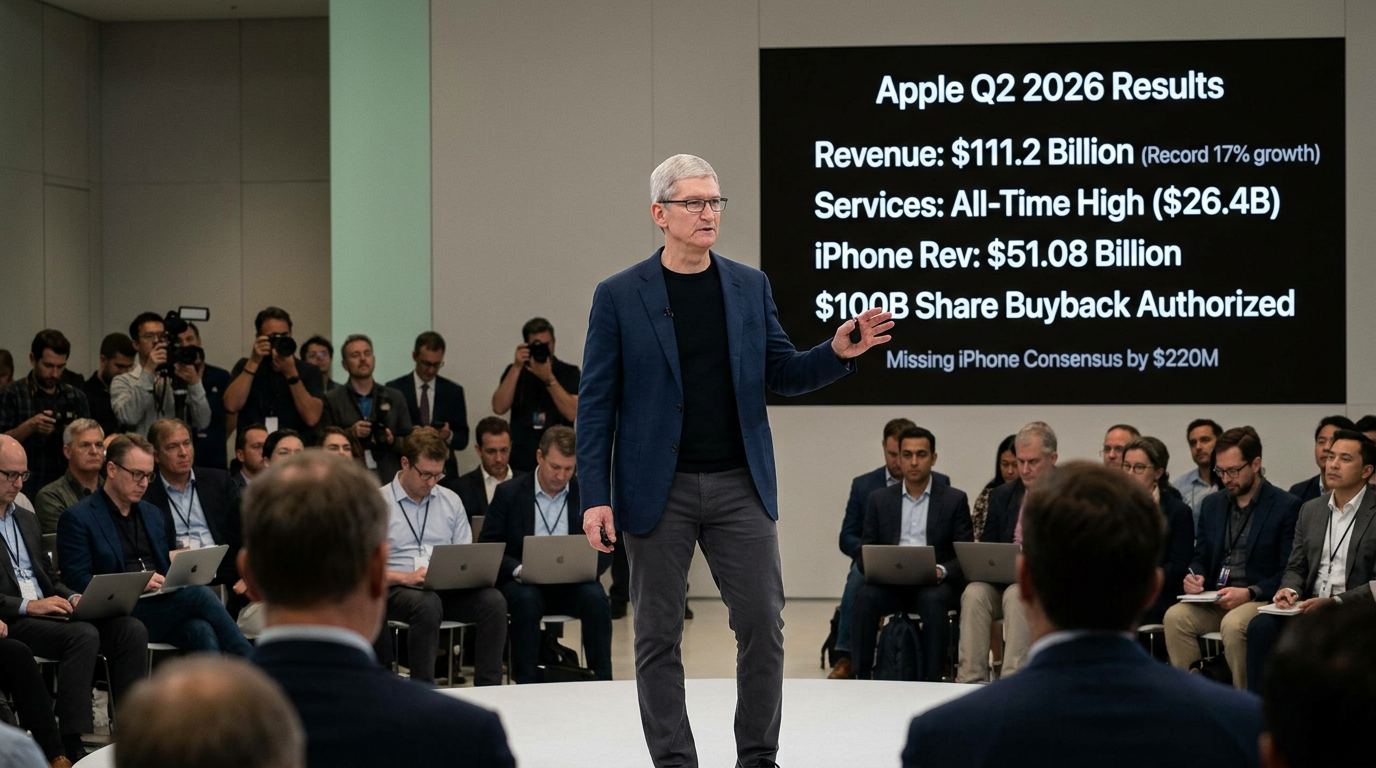
Let’s start with the number that matters most tonight: $111.2 billion. That’s what Apple reported for its fiscal second quarter — a second-quarter record, up 17% from $95.4 billion a year ago. The street was sitting at $109.7 billion. Apple beat it by a comfortable margin, posted EPS of $2.01 against a $1.95 consensus, and announced yet another $100 billion share buyback before most of Wall Street had finished their coffee.
So why did the stock drift lower in after-hours trading?
That’s the more interesting question tonight.
What Came In
The beat was broad. Almost every segment cleared the bar:
- Revenue: $111.18B vs. $109.66B expected
- EPS: $2.01 vs. $1.95 expected — up 22% year over year
- Services: $30.98B vs. $30.39B expected — all-time high
- Mac: $8.40B vs. $8.02B expected
- iPad: $6.91B vs. $6.66B expected
- Wearables: $7.90B vs. $7.70B expected
- Greater China: $20.50B vs. $19.45B expected
- Gross Margin: 49.3% vs. 48.4% expected
- iPhone: $56.99B vs. $57.21B expected — slight miss
One line in the wrong column. And it’s the one that still accounts for more than half the company’s total sales.
The miss was $220 million on a $57 billion number. Technically a rounding error. But the market doesn’t always deal in technicalities.
Apple’s Secret Weapon to Disrupt a $9 Trillion Industry
Apple just fired a shot at a $9 trillion sector – not with a new iPhone, but with its most disruptive project since the smartphone. One tiny supplier – still trading near $30 – sits quietly at the center of this bold move.
The iPhone Story Is Actually Good — Just Constrained
Here’s the context you need before reading the iPhone miss as anything alarming. iPhone sales in fiscal Q2 jumped 21.7% year over year to $56.99 billion — the best March-quarter iPhone result in Apple’s history. Cook didn’t hedge on this. He told Reuters that demand was exceptional. “The demand was off the charts,” he said. “And there’s just a little less flexibility in the supply chain at the moment for getting more parts.”
The constraint is real and specific. The iPhone 17 family — including the new iPhone Air — runs on an advanced TSMC chip that sits on the same manufacturing node used by leading AI processors. With AI infrastructure buildout consuming that node at an accelerating pace, Apple found itself competing for capacity with Nvidia and every hyperscaler on the planet. The result: Apple couldn’t fully meet demand, not because demand wasn’t there, but because the chips weren’t.
Whether that constraint persists into the June quarter is the open question. If it does, a quiet pre-iPhone-18 period becomes a lot more uncomfortable.
Services, on the other hand, had nothing to apologize for. Revenue hit a fresh all-time high at $30.98 billion, growing from $26.6 billion in the year-ago quarter. That’s roughly 16% growth in a segment that already generates gross margins north of 70%. The App Store, iCloud, Apple Pay, AppleCare, subscriptions — that engine just keeps compounding. And what’s worth sitting with: Services now contributes nearly half of Apple’s gross profit while representing less than a third of revenue. That math is why the multiple on this stock stays elevated even when the hardware misses.
Mac also had a moment. The segment came in at $8.40 billion against an $8.02 billion estimate, boosted in part by the MacBook Neo — a $500 laptop Apple launched earlier this year to go after the Chromebook market. That product is doing something unexpected: it’s pulling buyers from below rather than cannibalizing higher-margin Pro machines. Worth watching to see if the attach rate on Services holds as that lower-price buyer comes in.
China Came Back
Greater China revenue was $20.5 billion against a $19.45 billion estimate — a 28% jump from $16 billion a year ago. Independent shipment data from the March quarter pointed to a roughly 20% surge in iPhone shipments in the region, a sharp reversal from the softness that had been dragging on Apple’s China narrative for most of 2024 and early 2025. The iPhone 17 cycle is clearly resonating there, and Apple grew market share in the process.
Tariffs are still a background variable. Cook said Apple will reinvest any tariff refunds into new U.S. manufacturing. That’s the right answer politically. What it means for the cost structure is harder to model from the outside.
Satellite Confirms: Elon Musk Activating Strange ‘Dark Energy’ Across U.S. South
Confirmed by satellites 300 miles above the Earth’s surface… Elon Musk is rolling out a breakthrough technology that could replace our need for foreign oil and ignite a $10 trillion boom a small group of stocks.
Click here to learn how you can invest in this before it becomes mainstream.
The Memory Warning
This is the part of the call that didn’t get enough attention in the initial headlines.
Apple’s ability to absorb rising memory costs has held so far — gross margin actually came in at 49.3%, above both the guided range of 48–49% and the 48.4% consensus estimate. That’s impressive given the cost environment. But Cook flagged it explicitly: memory prices are rising because AI data centers are consuming DRAM and NAND at unprecedented rates, and Apple is competing for the same supply as everyone else. Cook warned the constraint won’t hold forever. “It’s only going to get harder,” he said, in describing Apple’s ability to prevent memory prices from flowing through to consumers.
The Q3 gross margin print is going to tell you a lot more than tonight’s number. If memory costs bite the way Cook’s language implies they might, the margin story gets messier in the back half of the year — right as the iPhone 18 launch window approaches.
Tim Cook’s Last Acts
On April 20, Apple announced that Tim Cook would step down as CEO effective September 1, moving to executive chairman, with John Ternus — Apple’s head of hardware engineering and a 25-year company veteran — succeeding him. The stock dropped 2.5% on the news. Tonight was the first earnings call since that announcement, and the messaging was unmistakably focused on continuity.
Cook’s tenure reshaped Apple into one of the most valuable companies in the world — market cap rising from roughly $350 billion when he took over to above $4 trillion today. The operational discipline, supply chain control, Services build-out, and relentless capital returns: that was all Cook. Ternus brings hardware engineering credibility. The ceiling for product ambition probably goes up. But the investor base right now isn’t asking for ambition — they’re asking for margin stability and AI clarity.
WWDC in June is the next major moment. Cook indicated Apple’s AI work with Google is progressing, and that a next-generation Siri is coming. The AI story at Apple is fundamentally different from what you saw rewarded this week at Alphabet or Amazon — it’s not about data center capex or cloud revenue, it’s about whether on-device intelligence is good enough to trigger the next mass upgrade cycle for the iPhone 18. That question is still open.
The Peer Context
Worth stepping back for a second. This earnings week was dominated by mega-cap AI spending. Alphabet surged nearly 10% on Google Cloud’s 63% growth and a $460 billion backlog. Meta fell after raising 2026 capex guidance to $125–$145 billion — the market decided that was too much spending. Microsoft slipped despite 40% Azure growth. The sector is rewarding AI capacity builds, not necessarily headline beats.
Apple’s situation is different. Minimal AI capex, a Services-led beat, and a consumer hardware business that just posted 17% revenue growth. In a week where the market wanted to see aggressive AI infrastructure investment, Apple was the company doing something else entirely — compounding quietly, returning cash, and betting that its 2.5 billion active devices are the distribution layer that ultimately matters more than any data center.
That’s the bet. The question is whether WWDC confirms it, or leaves the AI narrative hanging for another quarter.
In by 9:35 AM. Out by 10.
What if one simple pattern at the market open could hand you gains like 240% on META and 139% on GLD? The Opening Bell Trade Guide reveals the exact setup, the timing, and why this window keeps producing outsized wins. Download it free before we start charging for it.
Cheap Investor Scorecard
- Revenue $111.2B — Q2 record, beat by ~$1.5B
- EPS $2.01 — beat $1.95 estimate, up 22% YoY
- Gross margin 49.3% — above guidance and estimates
- Services $30.98B — all-time high, up ~16% YoY
- iPhone $56.99B — March-quarter record, slight miss vs. estimates due to supply
- Greater China $20.5B — up 28% YoY, beat by ~$1B
- Mac $8.40B — beat, MacBook Neo pulling weight
- Operating cash flow — $28B+ generated in quarter
- $100B share buyback authorized — dividend raised to $0.27/share (+4%)
- Memory cost warning — explicit flag for Q3 and beyond
- CEO transition Sept. 1 — Ternus continuity message delivered
- WWDC AI catalyst — next-gen Siri, June
The bottom line is straightforward: Apple delivered a record quarter with a broad beat, a clean margin expansion, and another massive capital return program. The iPhone miss was supply-driven, not demand-driven — and the company’s own data makes that case convincingly.
What’s less clean is the forward picture. Memory cost headwinds are real and explicitly flagged. The TSMC supply constraint on advanced chips isn’t going away overnight. And a new CEO takes over in five months, into a product cycle — iPhone 18 and whatever Apple shows at WWDC — that will define the next two years of the thesis.
The stock at $270-something and a 34x P/E gives you almost no cushion if any of those variables slip. Watch Q3 gross margin more closely than any other number Apple reports for the rest of this year.
– The Cheap Investor