
April 27, 2026
SpaceX Wants $1.75 Trillion.
Roadshow kicks off June 8, the prospectus lands in late May, and the real question isn’t whether this company is extraordinary – it’s whether the price leaves any room for you
Hey there, bargain hunter.
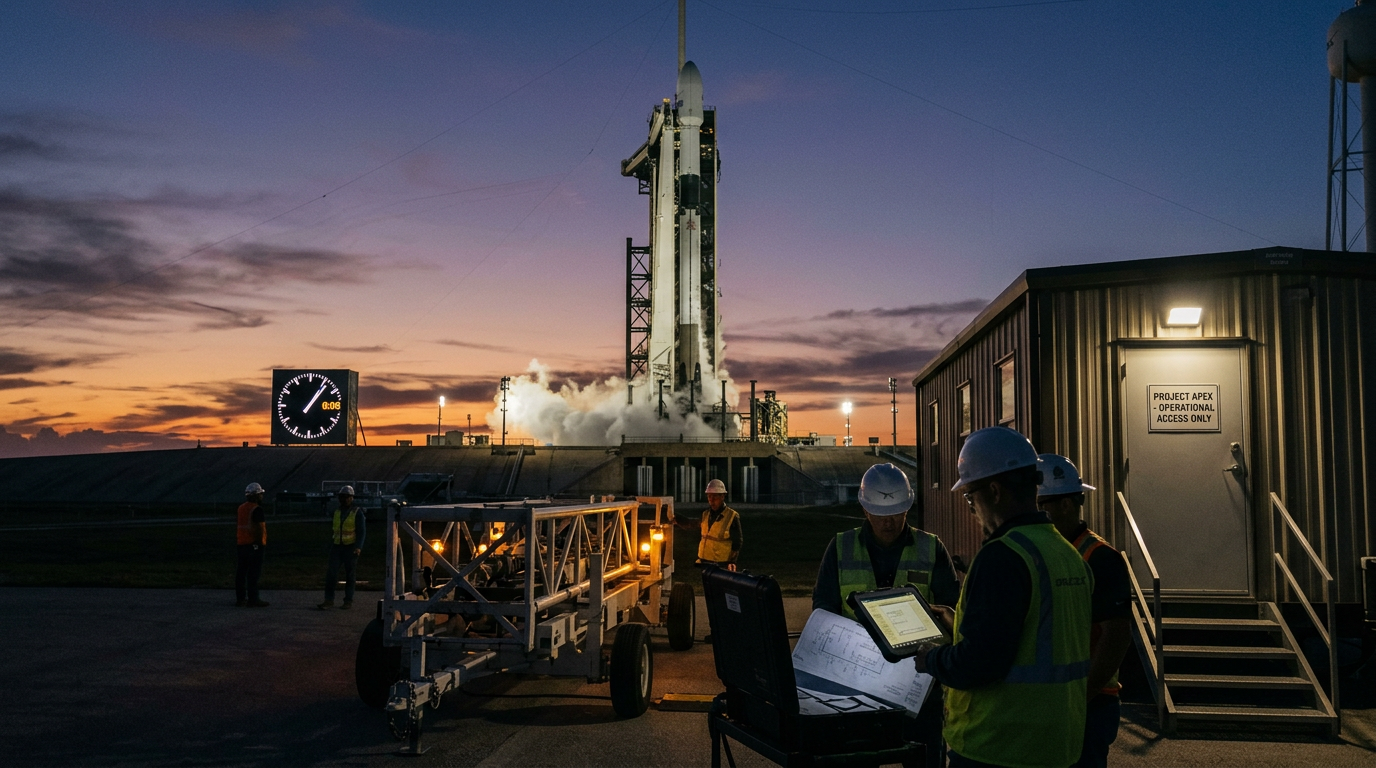
The SpaceX IPO is no longer a rumor. It’s a confidential SEC filing, a June listing target, a roadshow kicking off the week of June 8, and a valuation that would make it the largest public offering in stock market history. The internal codename is “Project Apex.” Either someone in the comms department has a great sense of humor, or no one thought twice about it.
The number being thrown around: $1.75 trillion. Some banker chatter pushes it toward $2 trillion depending on how book-building goes. Either way, you’d be buying into a company valued on par with Amazon – on day one, before a single quarter of public earnings.
Let’s look at what you’re actually buying.
The Business – All Three of It
SpaceX is three companies stapled together. There’s the rocket business – Falcon 9, Falcon Heavy, and the not-yet-commercial Starship program. There’s Starlink, the satellite broadband service that has quietly become the most important revenue engine in the whole structure. And since February 2026, there’s xAI, Elon Musk’s artificial intelligence venture, absorbed into SpaceX in an all-stock deal that valued xAI at roughly $250 billion and pushed the combined entity’s private valuation to $1.25 trillion – before the IPO markup.
The xAI piece is what makes this complicated. On one hand, it adds Grok, a GPU cluster, and a theoretical path to orbital data centers – compute infrastructure in space, powered by Starlink’s global backbone. On the other hand, it’s a cash furnace. According to data reported by The Information, xAI burned $9.5 billion in just the first three quarters of 2025, against revenue of roughly $210 million over the same stretch. That’s not a typo.
Starlink is carrying the weight. The numbers here are legitimately impressive: roughly $11.4 billion in revenue for 2025, a 63% EBITDA margin, and a user base that crossed 10 million active subscribers by February 2026 – doubling in a single year. Aviation is growing nearly tenfold year-over-year. Maritime is on track for $1.9 billion in 2026 revenue, up 55%. Starshield, the government and defense division, is projected to contribute $3.2 billion this year alone. These aren’t speculative numbers. Starlink is a real business.
The launch business is still dominant in terms of infrastructure, but growth is slowing. And here’s something that doesn’t get enough attention: capital spending surged past revenue last year, with capex exceeding sales by roughly $2 billion. SpaceX is investing aggressively in the AI and Starship buildout – which is fine if the bet pays, and genuinely problematic if it doesn’t.
1.5M People Ditched Their Monitors
That’s not a marketing claim. It’s what’s actually happening. All thanks to Immersed.
Immersed built a virtual environment where professionals do their actual jobs without limiting themselves to a single screen. It’s not a prototype or PRE REVENUE. 1.5M people use it as their primary workspace right now. Even Fortune 500 companies run daily operations inside it.
The business is real and gaining momentum. Even big tech is getting involved. Partnerships with Meta, Intel, Qualcomm, and Samsung don’t just happen. Speaking of Meta, it’s the No. 1 productivity app in the Meta Quest Store.
Former Intel CEO Pat Gelsinger invested. In total $28M+ raised from 7,000+ investors and the NASDAQ ticker reserved is: $IMRS.
Immersed is running a Regulation A+ offering to get more people involved. It’s the same structure that allows retail investors to get in on a raise that would traditionally require institutional access. Pre-IPO shares are $0.72. Early investors can qualify for up to 20% bonus shares.
Round ends May 14th and the price won’t stay at $0.72 forever.
Join the 7k+ investors in this workplace revolution
Disclosure: This is a paid advertisement for Immersed Regulation A+ offering. Please read the offering circular at https://invest.immersed.com/
The Retail Angle – Unusual, But Not a Gift
Here’s something that doesn’t show up in most big IPOs. CFO Bret Johnsen told the full syndicate of 21 banks that retail investors will represent a larger share of this offering than any IPO in history – targeting up to 30% of shares for individual buyers, versus the typical 5–10%. On June 11, the company plans to host 1,500 retail investors at what’s being described as a major investor event. Retail access is also being extended internationally – UK, EU, Australia, Canada, Japan, and Korea are all included.
Whether that results in meaningful allocations for ordinary brokerage accounts is still unclear. The mechanics aren’t public yet. But the intent is genuine, and it shifts the demand picture heading into pricing.
Slight tangent, but it matters here: SpaceX holds 8,285 BTC in Coinbase Prime custody – worth roughly $600 million at current levels. That makes this the first major IPO to go public with a material bitcoin position disclosed under the new fair-value accounting rules that took effect in late 2024. It’s a footnote, but it’s a real one.
The Price Is the Problem
At $2 trillion, you’re paying roughly 125x 2025 revenue. At $1.75 trillion, the multiple is closer to 109x. Either way, that is more expensive than Tesla. More expensive than Palantir. More expensive than essentially any publicly traded company at scale. The valuation financials reflect the current numbers: roughly $15–16 billion in total 2025 revenue, with Starlink contributing 61% of sales and virtually all of the EBITDA. xAI is not a profit center – it’s a bet.
The IPO filing apparently claims a $28.5 trillion total addressable market, with AI infrastructure as the primary driver. To put that in context, Uber cited a $5.7 trillion opportunity at its 2019 IPO. TAM numbers are not revenue projections. They’re permission structures for a certain kind of optimism.
The honest version of the bull case: Starlink keeps compounding – subscribers, aviation contracts, maritime deals, direct-to-cell – and the marginal cost of adding users stays low. The orbital data center concept eventually becomes real. xAI finds commercial footing. The multiple looks absurd in hindsight the way early Amazon always did.
The honest version of the bear case is simpler. You’re buying a loss-generating AI division attached to a satellite business, at a premium that has no real public market comparable, right before a 180-day lockup expires between mid and late December. When insiders can sell, they often do.
The Fast Facts
- IPO target: June 2026 – roadshow begins week of June 8
- Prospectus (S-1) expected: May 15–22
- Valuation range: $1.75T–$2T
- Target raise: ~$75B (would exceed all U.S. IPO proceeds from 2024 and 2025 combined)
- Retail allocation: up to 30% (vs. typical 5–10%)
- Starlink 2025 revenue: ~$11.4B, 63% EBITDA margin, 10M subscribers as of Feb 2026
- xAI cash burn: ~$9.5B in first three quarters of 2025, ~$210M in revenue same period
- Total 2025 company revenue: ~$15–16B
- Revenue multiple at IPO: ~109x–125x 2025 revenue
- BTC on balance sheet: 8,285 BTC (~$600M)
- Lockup expiry: estimated Dec 15–27, 2026
- Pre-IPO exposure options: GOOGL (~6.1% stake, $100B+ at $1.75T), ARK Venture Fund (ARKVX), Baron Partners Fund (BPTRX)
- Kalshi betting market: ~83% of participants expect IPO before July 1
The Countdown Begins
When SpaceX goes public, it could hit a $1.75 TRILLION valuation – that would be 3,000 times bigger than Amazon’s IPO.
Most investors will be locked out until AFTER the big announcement.
But I’ve discovered a “backdoor” that lets you grab a pre-IPO stake in SpaceX right now.
I’m revealing the ticker for free.
There’s one more thing worth sitting with. SpaceX, OpenAI, and Anthropic are all expected to go public in a roughly six-month window this year – with a combined raise potentially north of $240 billion. For context, the entire U.S. IPO market raised about $45 billion in all of 2025. The capital has to come from somewhere. When it flows toward three mega-listings, it tends to flow away from everything else. That’s not a reason to avoid SpaceX. It’s a reason to be clear-eyed about the macro setup around the trade.
Here’s where I’m at. The financials still look like a rocket-and-satellite company. The valuation looks like an AI infrastructure giant that hasn’t quite arrived yet. Both of those things are true at once, and you’re being asked to pay for the second one before it shows up in the numbers.
The prospectus goes public in late May. That’s when the real conversation starts.